Demonstrations by Unions Against Government Austerity Measures Hobble Transit Services, Spark Clashes With Police
ATHENS—Flights were grounded and trains suspended amid a nationwide general strike Thursday, as Greek police fought running street battles with anarchist youths in fresh and violent signs of anger at the government's austerity plans. Unions called a strike to protest wage and benefit cuts being put in place to trim Greece's swollen budget deficit as the country draws closer to a financial reckoning. An estimated 50,000 people took to the streets.
What is the alternative?
Greece must refinance a chunk of its giant debt next month, and Greek leaders are leaning hard on counterparts in richer European states to provide some measure of support that could ease those debt sales. Eyes are on European Union finance ministers' meetings early next week.
In the capital city Thursday, masked and hooded youths went well beyond protest—throwing rocks and bottles, smashing shop windows, setting alight trash cans and burning at least one private car. Police fired tear gas and detained more than a dozen people. There were also separate clashes outside the Greek parliament, Agence France-Presse reported. Greece has a history of sometimes-violent anarchist protesters, though they are well outside the mainstream.
Greece's two umbrella unions, for private- and public-sector workers, called the strike to protest the €4.8 billion ($6.55 billion) package of spending cuts and tax increases that the government announced March 3, which was voted into law days later. The communist-backed PAME union held a separate protest that drew an estimated 15,000 people.
Communists? They're still around? Haven't they gotten the news?
"There is a big turnout today and that shows people are concerned," said Dimitris Papageorgiou, a 49-year-old worker at the Bank of Greece. "Today's protest is because of the austerity measures. Why do the people always have to pay? Who is at fault? It's the foreign speculators and the useless policies of previous governments."
Recent polls show that the Greek public is divided over the austerity plan. While the public opposes some measures, such as an increase in Greece's fuel and value-added taxes, analysts say there is a broad acceptance that something must be done. "No one really expects the measures to be withdrawn. They were adopted by the government to avoid even worse consequences," said Lefteris Eleftheriadis, 48, a biologist who works in Greece's agriculture ministry and participated in Thursday's protest.
The strike affected public transport, government ministries and state-owned companies. All flights into and out of the country were grounded and all ferry and rail services suspended. On the streets of Athens Thursday, normal workday activity was muted. Street lights and road signs were festooned with strike posters. Usual morning news shows on local television were replaced with alternative programming. Many businesses were shut amid fear of violence, and police blocked main thoroughfares around the city center. Just off the city's central square, a group of about 200 police and fire officials also staged a sympathy protest, challenging the government to fulfill its pre-election promises to protect workers' salaries.
How?
Under pressure from the EU and financial markets, Greece's socialist government last week presented the latest in a series of austerity packages to trim the budget deficit to 8.7% of gross domestic product this year, from an estimated 12.7% last year. Among other things, the package raises Greece's top value-added tax rate to 21% from 19%, freezes public-sector pensions, cuts civil-service entitlements and bonus pay, and raises taxes on fuel, alcohol and cigarettes.
The general strike follows several days of escalating labor actions by a variety of smaller unions.
— By ALKMAN GRANITSAS. Charles Forelle contributed to this article.
Printed in The Wall Street Journal, page A13
Showing posts with label Greece. Show all posts
Showing posts with label Greece. Show all posts
Friday, March 12, 2010


Thursday, February 25, 2010
Financial equivalent of a four-alarm fire

Bets by some of the same banks that helped Greece shroud its mounting debts may actually now be pushing the nation closer to the brink of financial ruin. Echoing the kind of trades that nearly toppled the American International Group, the increasingly popular insurance against the risk of a Greek default is making it harder for Athens to raise the money it needs to pay its bills, according to traders and money managers.
These contracts, known as credit-default swaps, effectively let banks and hedge funds wager on the financial equivalent of a four-alarm fire: a default by a company or, in the case of Greece, an entire country. If Greece reneges on its debts, traders who own these swaps stand to profit.
“It’s like buying fire insurance on your neighbor’s house — you create an incentive to burn down the house,” said Philip Gisdakis, head of credit strategy at UniCredit in Munich.
And reform is dead in the US Senate; a repeal of the laws allowing banks to use their own capital for investment banking will not pass. What will it take for reform to pass? The US economy almost fell off the edge. Greece is teetering, and if it falls the repercussions in Europe will be awful.
Wednesday, July 15, 2009
The Gyro’s History Unfolds
CARVED Gyros with tzatziki at the Kronos Foods factory in Chicago.

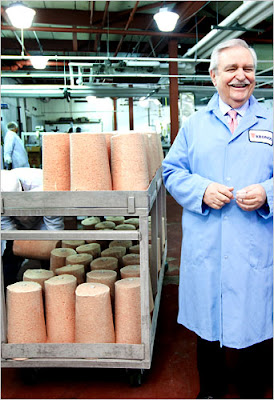
Mr. Tomaras opened Kronos in 1975 and sold it to a private equity firm in 1994. But he returned to the plant, on a dead-end industrial road in Chicago’s southwest side, to explain how gyros are made. It’s a show and tell that is not for the squeamish.
It is a mystery meat.
PRE-PITA Chris Tomaras, the founder of Kronos Foods, with uncooked gyro cones.
The question is: Who is the Henry Ford of the gyro? It turns out there are a handful of contenders, all of whom know one another and have been friendly competitors for decades. They include George Apostolou, who says he served the first gyros in the United States, in the Parkview Restaurant in Chicago, in 1965, and nine years later opened a 3,000-square-foot manufacturing plant, Central Gyros Wholesale.
another contender, Andre Papantoniou, a founder and the president of Olympia Food Industries, says the gyro plant was actually the brainchild of the improbably named John Garlic.
This initially sounds like a joke, but Mr. Papantoniou swears that during the rotisserie-making phase of Mr. Parthenis’s career, one John Garlic showed up in Chicago in search of a partner in a gyro plant he’d started in Milwaukee.
It’s true, Mr. Parthenis said in a second call, though he remembers little about his former partner, except that the guy looked like a hippie. Who Mr. Garlic was and why he made gyros are questions that Mr. Parthenis can’t answer: “He was like a phantom. He came out of nowhere.”
There is little about John Garlic in news archives, aside from a 1978 story in The Milwaukee Sentinel, in which a John J. Garlic discusses his plans to keep trained dolphins in a former municipal pool he’d bought in the city and wanted to turn into a restaurant with a kind of Sea World sideshow.
Unfortunately, Mr. Garlic is no longer around to discuss matters; he died of kidney failure in 1994. But his wife, Margaret Garlic, can provide answers.
So, who was John Garlic?
“He was this big guy,” she said, “like 6 foot 2 inches tall, dark curly hair, couple hundred pounds. A former Marine. A super intelligent, super entertaining man. My brother used to say, ‘When John Garlic enters a room, you know you’re going to have fun.’ ”
And he was Greek?
“No, no,” she said. “He was Jewish.”
YOu can't make this stuff up.

Mr. Tomaras opened Kronos in 1975 and sold it to a private equity firm in 1994. But he returned to the plant, on a dead-end industrial road in Chicago’s southwest side, to explain how gyros are made. It’s a show and tell that is not for the squeamish.
It is a mystery meat.
PRE-PITA Chris Tomaras, the founder of Kronos Foods, with uncooked gyro cones.

The question is: Who is the Henry Ford of the gyro? It turns out there are a handful of contenders, all of whom know one another and have been friendly competitors for decades. They include George Apostolou, who says he served the first gyros in the United States, in the Parkview Restaurant in Chicago, in 1965, and nine years later opened a 3,000-square-foot manufacturing plant, Central Gyros Wholesale.
another contender, Andre Papantoniou, a founder and the president of Olympia Food Industries, says the gyro plant was actually the brainchild of the improbably named John Garlic.
This initially sounds like a joke, but Mr. Papantoniou swears that during the rotisserie-making phase of Mr. Parthenis’s career, one John Garlic showed up in Chicago in search of a partner in a gyro plant he’d started in Milwaukee.
It’s true, Mr. Parthenis said in a second call, though he remembers little about his former partner, except that the guy looked like a hippie. Who Mr. Garlic was and why he made gyros are questions that Mr. Parthenis can’t answer: “He was like a phantom. He came out of nowhere.”
There is little about John Garlic in news archives, aside from a 1978 story in The Milwaukee Sentinel, in which a John J. Garlic discusses his plans to keep trained dolphins in a former municipal pool he’d bought in the city and wanted to turn into a restaurant with a kind of Sea World sideshow.
Unfortunately, Mr. Garlic is no longer around to discuss matters; he died of kidney failure in 1994. But his wife, Margaret Garlic, can provide answers.
So, who was John Garlic?
“He was this big guy,” she said, “like 6 foot 2 inches tall, dark curly hair, couple hundred pounds. A former Marine. A super intelligent, super entertaining man. My brother used to say, ‘When John Garlic enters a room, you know you’re going to have fun.’ ”
And he was Greek?
“No, no,” she said. “He was Jewish.”
YOu can't make this stuff up.
Friday, December 12, 2008
Greece is Burning
 This person has a very definite opinion about what is going on in Greece.
Plundering thugs who are following their own self-interests.
When Greece's conservative New Democracy party came to power in March 2004 it promised three things: to "reinvent" the state, to eliminate corruption, and to initiate much-needed educational reform. Four years later, the situation remains unchanged: The state is still a tool for bestowing benefits and favors, corruption in the public sector is still rampant, and attempts at educational reform have fizzled out.
That sets the context of where Greece is now: promised change not delivered, corruption, favoritism, cynicism. Not a good combination, at all.
The ostensible cause for the rioting was the killing – under circumstances that remain unclear – of a 15-year-old boy by a policeman last Saturday near the Athens district of Exarchia, a popular hangout for lefties and professed anarchists. Two officers have been arrested and charged with the boy's slaying. Poor training, lack of motivation and low salaries make for a notoriously incompetent police force whose members are prone to cause such tragic incidents. In that sense the police share the malaise of the rest of the public sector in Greece. The only difference is that they carry arms.
The writer works for Eleftherotypia, an Athens newspaper retaining its traditional socialist domestic and international stance.Thus, using terms such as lefties isn't to be taken as a rightist disparaging leftists.
The death quickly led to mostly peaceful mass demonstrations all over Greece by students who were understandably unhappy with the killing of their peer. They are also fed up with an overcentralized education system that thrives on rote learning, which stifles innovation and creativity.
Wednesday, December 10, 2008
Strikes Cripple a Riot-Shaken Greece

Louisa Gouliamaki/Agence France-Presse — Getty Images
A protester threw a Molotov cocktail at Greek riot police outside the Parliament in Athens on Wednesday.
I do not understand the first thing about this; I need to do some reading on it.
Saturday, October 18, 2008
Battle of Thermopylae
103 Across: victor at Thermopylae: Xerxes. Thermopylae was the site of a battle fought in August 480 BC, between an alliance of Greek city-states and the invading Persian Empire of Xerxes I, at the pass of Thermopylae in central Greece.


Subscribe to:
Posts (Atom)