Obama's Willingness to Continue Bush Approach to Religious Charities Aims to Woo Evangelicals but Vexes Liberals
This story tells a great deal about politics, both contemporary and in general.
President Barack Obama's willingness to keep Bush-era policies on government-backed religious charities has angered many liberals but is helping to woo traditionally Republican evangelical leaders who can influence key blocs of voters. The approach, according to conservative leaders and liberal critics alike, is part of a broader strategy by Mr. Obama and fellow Democrats to regain credibility with centrist and conservative voters who tend to be more religious and have supported the GOP in recent polls and elections.
Cold calculations tell: the President needs support from more than the left wing of the Democratic Party to keep power.
Mr. Obama has left in place a contentious Bush policy permitting charities that receive federal aid to hire employees based on their religious beliefs—a policy that civil-liberties groups consider unconstitutional and that candidate Obama had criticized.
Candidates say many things to get elected, but, once in power, recalibrate. It is always done. Liberals insist on ideological orthodoxy, as if simply being rigidly liberal is going to accomplish a great deal politically. It would not. Obama is not as liberal as liberals thought he would be, as they thought they saw him being. He woos liberals, yes, but he is not as liberal as conservatives and right wing nuts charge him with being. And, anyway, what is so bad about faith-based programs? Liberals have their own litmus test; why shouldn't others have their own? Liberals are far too sanctimonious.
Showing posts with label Conservatives. Show all posts
Showing posts with label Conservatives. Show all posts
Sunday, February 7, 2010


Tuesday, December 22, 2009
Signs of Polarization
December 22, 2009 - Sidebar
In Supreme Court Clerks’ Careers, Signs of Polarization
By ADAM LIPTAK
WASHINGTON
A Supreme Court clerkship really brightens the legal résumé, and former clerks have their pick of the best jobs at law firms, in the academy and in government.
The career choices they make also say something important about the state of the Supreme Court. A new study has found that former clerks have started to take jobs that reflect the ideologies of the justices for whom they worked.
“It’s cause for concern mainly because it’s a further piece of evidence of the polarization of the court,” said William E. Nelson, a law professor at New York University and one of the authors of the study.
I am no longer so sure that the claims and beliefs that our times are more polarized than others is true or accurate.
Until about 1990, the study shows, there was no particular correlation between a justice’s ideological leanings and what his or her clerks did with their lives.
Clerks from conservative chambers are now less likely to teach. If they do, they are more likely to join the faculties of conservative and religious law schools. Republican administrations are now much more likely to hire clerks from conservative chambers, and Democratic administrations from liberal ones. Even law firm hiring splits along ideological lines.
Does that say anything about academia being a liberal bastion?
Earlier studies have shown the rise of ideological hiring of clerks by the justices. In recent years, the more conservative justices have overwhelmingly hired clerks who had worked for appeals court judges appointed by Republicans. The more liberal justices did the opposite, but a little less consistently.
The new study, published last month in The Vanderbilt Law Review and summarized in the autumn issue of The Green Bag, collected data from 1882 through 2006, which means it did not consider information about clerks for the most recent additions to the court, Chief Justice John G. Roberts Jr. and Justices Samuel A. Alito Jr. and Sonia Sotomayor.
Before the 1990s, the study found, all sorts of former clerks served in the government under all sorts of administrations. That seemed to change in the Clinton years. The Clinton administration hired 96 former clerks, but only 16 percent of them came from the chambers of the four most conservative justices — Chief Justice William H. Rehnquist and Justices Antonin Scalia, Clarence Thomas and Anthony M. Kennedy.
Of the 89 former clerks hired by the administration of George W. Bush, on the other hand, 68 percent came from those four chambers.
“The only other justice who provided five or more clerks for President Bush was the fifth justice who cast a vote in his favor in Bush v. Gore,” the study said, referring to former Justice Sandra Day O’Connor, whose chambers provided eight additional clerks.
From about 1940 to 1990, the study found, about a third of all clerks became law professors. There was variation among the chambers, but it was not correlated to the justices’ ideological leanings.
The rise of the organized conservative legal movement, including notably the Federalist Society, seems to have changed that, perhaps as a result of the sense among conservatives that law school faculties are overwhelmingly liberal.
“Certain kids coming out of the conservative movement were not feeling comfortable with traditional law schools,” said Harvey Rishikof, another author of the study and a law professor at the National War College. (I. Scott Messinger and Michael Jo also worked on the study.)
Or perhaps colleges, law schools, were not seen as the appropriate forum to fight the conservative battle.
Only 19 percent of clerks from the four most conservative justices in recent decades joined the legal academy and only 7 percent went to one of the top 10 law schools in the annual survey published by U.S. News & World Report. A significant minority joined the faculties of religious or conservative law schools.
Clerks for the other five justices followed the historical pattern, with 34 percent joining the legal academy, about half of them at the elite schools. The study also showed polarized hiring at the law firms with significant Supreme Court practices.
Kirkland & Ellis, for instance, hired 22 former clerks from 1990 to 2006, all from the four most conservative chambers, according to the study. (A Kirkland spokesman added that the firm also hired two former clerks to Justice Byron R. White.) The firm is home to Kenneth W. Starr, the former Whitewater prosecutor who was solicitor general in the administration of the first President George Bush.
And President Clinton shadow. No surprise here.
Wilmer Cutler Pickering Hale & Dorr, on the other hand, hired 35 clerks from the five more liberal justices and only 5 from the other four. Seth P. Waxman, a solicitor general in the Clinton administration, leads the firm’s Supreme Court practice.
The emergence of “politically oriented practice groups,” the study said, reinforces the idea that the court is “a superlegislature responding to ideological arguments rather than a legal institution responding to concerns grounded in the rule of law.”
Is that more partisan, or more realistic?
In his 2006 book on Supreme Court clerks, “Courtiers of the Marble Palace: The Rise and Influence of the Supreme Court Law Clerk,” Todd C. Peppers wrote that “no other internship program in the history of the United States has produced as impressive and diverse a collection of individuals as the U.S. Supreme Court law clerk corps.”
Professor Peppers, who teaches public affairs at Roanoke College, said he was fascinated by the new study’s findings. But he added that the recent trends were in a way unsurprising. “Do justices select like-minded clerks?” he asked. “Of course.”
Exactly.
“And do these clerks go into private practice, government work and the legal academy and use their legal skills to promote ideological views that are compatible with their justices? Of course.”
That may be obvious, but it is not easy to reconcile with the view that that law and politics are, or at least ought to be, different realms.
Dream
In Supreme Court Clerks’ Careers, Signs of Polarization
By ADAM LIPTAK
WASHINGTON
A Supreme Court clerkship really brightens the legal résumé, and former clerks have their pick of the best jobs at law firms, in the academy and in government.
The career choices they make also say something important about the state of the Supreme Court. A new study has found that former clerks have started to take jobs that reflect the ideologies of the justices for whom they worked.
“It’s cause for concern mainly because it’s a further piece of evidence of the polarization of the court,” said William E. Nelson, a law professor at New York University and one of the authors of the study.
I am no longer so sure that the claims and beliefs that our times are more polarized than others is true or accurate.
Until about 1990, the study shows, there was no particular correlation between a justice’s ideological leanings and what his or her clerks did with their lives.
Clerks from conservative chambers are now less likely to teach. If they do, they are more likely to join the faculties of conservative and religious law schools. Republican administrations are now much more likely to hire clerks from conservative chambers, and Democratic administrations from liberal ones. Even law firm hiring splits along ideological lines.
Does that say anything about academia being a liberal bastion?
Earlier studies have shown the rise of ideological hiring of clerks by the justices. In recent years, the more conservative justices have overwhelmingly hired clerks who had worked for appeals court judges appointed by Republicans. The more liberal justices did the opposite, but a little less consistently.
The new study, published last month in The Vanderbilt Law Review and summarized in the autumn issue of The Green Bag, collected data from 1882 through 2006, which means it did not consider information about clerks for the most recent additions to the court, Chief Justice John G. Roberts Jr. and Justices Samuel A. Alito Jr. and Sonia Sotomayor.
Before the 1990s, the study found, all sorts of former clerks served in the government under all sorts of administrations. That seemed to change in the Clinton years. The Clinton administration hired 96 former clerks, but only 16 percent of them came from the chambers of the four most conservative justices — Chief Justice William H. Rehnquist and Justices Antonin Scalia, Clarence Thomas and Anthony M. Kennedy.
Of the 89 former clerks hired by the administration of George W. Bush, on the other hand, 68 percent came from those four chambers.
“The only other justice who provided five or more clerks for President Bush was the fifth justice who cast a vote in his favor in Bush v. Gore,” the study said, referring to former Justice Sandra Day O’Connor, whose chambers provided eight additional clerks.
From about 1940 to 1990, the study found, about a third of all clerks became law professors. There was variation among the chambers, but it was not correlated to the justices’ ideological leanings.
The rise of the organized conservative legal movement, including notably the Federalist Society, seems to have changed that, perhaps as a result of the sense among conservatives that law school faculties are overwhelmingly liberal.
“Certain kids coming out of the conservative movement were not feeling comfortable with traditional law schools,” said Harvey Rishikof, another author of the study and a law professor at the National War College. (I. Scott Messinger and Michael Jo also worked on the study.)
Or perhaps colleges, law schools, were not seen as the appropriate forum to fight the conservative battle.
Only 19 percent of clerks from the four most conservative justices in recent decades joined the legal academy and only 7 percent went to one of the top 10 law schools in the annual survey published by U.S. News & World Report. A significant minority joined the faculties of religious or conservative law schools.
Clerks for the other five justices followed the historical pattern, with 34 percent joining the legal academy, about half of them at the elite schools. The study also showed polarized hiring at the law firms with significant Supreme Court practices.
Kirkland & Ellis, for instance, hired 22 former clerks from 1990 to 2006, all from the four most conservative chambers, according to the study. (A Kirkland spokesman added that the firm also hired two former clerks to Justice Byron R. White.) The firm is home to Kenneth W. Starr, the former Whitewater prosecutor who was solicitor general in the administration of the first President George Bush.
And President Clinton shadow. No surprise here.
Wilmer Cutler Pickering Hale & Dorr, on the other hand, hired 35 clerks from the five more liberal justices and only 5 from the other four. Seth P. Waxman, a solicitor general in the Clinton administration, leads the firm’s Supreme Court practice.
The emergence of “politically oriented practice groups,” the study said, reinforces the idea that the court is “a superlegislature responding to ideological arguments rather than a legal institution responding to concerns grounded in the rule of law.”
Is that more partisan, or more realistic?
In his 2006 book on Supreme Court clerks, “Courtiers of the Marble Palace: The Rise and Influence of the Supreme Court Law Clerk,” Todd C. Peppers wrote that “no other internship program in the history of the United States has produced as impressive and diverse a collection of individuals as the U.S. Supreme Court law clerk corps.”
Professor Peppers, who teaches public affairs at Roanoke College, said he was fascinated by the new study’s findings. But he added that the recent trends were in a way unsurprising. “Do justices select like-minded clerks?” he asked. “Of course.”
Exactly.
“And do these clerks go into private practice, government work and the legal academy and use their legal skills to promote ideological views that are compatible with their justices? Of course.”
That may be obvious, but it is not easy to reconcile with the view that that law and politics are, or at least ought to be, different realms.
Dream
Monday, December 14, 2009
Under Murdoch, tilting rightward
Rupert Murdoch, a lifelong conservative, addressing the newsroom at The Wall Street Journal two years ago, when he took over.

Not that the Wall Street Journal was a leftists rag and needed a push to the right; if anything, they were a perfect match.
Glenn R. Simpson, who left the newspaper back in March, is not a fan of the newsier, less analytical Journal.
“Murdoch didn’t ruin The Wall Street Journal; he just rendered it into a much more ordinary paper,” he said.
But there are growing indications that Mr. Murdoch, a lifelong conservative, doesn’t just want to cover politics, he wants to play them as well.
He has always played politics. Perhaps he is becoming less covert, but the change is of style, not substance.
According to several former members of the Washington bureau and two current ones, the two men have had a big impact on the paper’s Washington coverage, adopting a more conservative tone, and editing and headlining articles to reflect a chronic skepticism of the current administration. And given that the paper’s circulation continues to grow, albeit helped along by some discounts, there’s nothing to suggest that The Journal’s readers don’t approve.
More conservative? I don't notice the change; the paper was always conservative. And subscribing to the paper does not equate to approving of its politics.
In response to questions about bias in the newspaper, a Journal spokesman sent along the following statement: “The Journal has always provided its readers with unique, objective news reporting from our Washington Bureau.”
Oy. Fair and balanced?
Tension between Washington bureaus and headquarters is a common feature of newspapers, and none of the people I spoke to suggested that either Mr. Thomson or Mr. Baker lacked savvy as journalists or leaders — only that ideology was baked into the coverage through headlines, assignments and editing in a way that had never occurred in the past.

Not that the Wall Street Journal was a leftists rag and needed a push to the right; if anything, they were a perfect match.
Glenn R. Simpson, who left the newspaper back in March, is not a fan of the newsier, less analytical Journal.
“Murdoch didn’t ruin The Wall Street Journal; he just rendered it into a much more ordinary paper,” he said.
But there are growing indications that Mr. Murdoch, a lifelong conservative, doesn’t just want to cover politics, he wants to play them as well.
He has always played politics. Perhaps he is becoming less covert, but the change is of style, not substance.
According to several former members of the Washington bureau and two current ones, the two men have had a big impact on the paper’s Washington coverage, adopting a more conservative tone, and editing and headlining articles to reflect a chronic skepticism of the current administration. And given that the paper’s circulation continues to grow, albeit helped along by some discounts, there’s nothing to suggest that The Journal’s readers don’t approve.
More conservative? I don't notice the change; the paper was always conservative. And subscribing to the paper does not equate to approving of its politics.
In response to questions about bias in the newspaper, a Journal spokesman sent along the following statement: “The Journal has always provided its readers with unique, objective news reporting from our Washington Bureau.”
Oy. Fair and balanced?
Tension between Washington bureaus and headquarters is a common feature of newspapers, and none of the people I spoke to suggested that either Mr. Thomson or Mr. Baker lacked savvy as journalists or leaders — only that ideology was baked into the coverage through headlines, assignments and editing in a way that had never occurred in the past.
Monday, September 14, 2009
Because They Believe
 In his new book, Norman Podhoretz has some fine exasperated fun with the wildness of interpretation on the Jewish left, and of course spares the Jewish right any culpability for the same sin. So it is worth recalling that a few years ago he published a book about the prophets in which they emerged as the neoconservatives of ancient Israel. Their castigations of the sacrifice of children prompted a reflection on the “pagan practice” of the entry of women into the work force.
Another fine conservative tenet, this paganism.
Norman Podhoretz loves his people and loves his country, and I salute him for it, since I love the same people and the same country. But this is a dreary book. Its author has a completely axiomatic mind that is quite content to maintain itself in a permanent condition of apocalyptic excitation. His perspective is so settled, so confirmed, that it is a wonder he is not too bored to write. The veracity of everything he believes is so overwhelmingly obvious to him that he no longer troubles to argue for it. Instead there is only bewilderment that others do not see it, too. “Why Are Jews Liberals?” is a document of his bewilderment; and there is a Henry Higgins-like poignancy to his discovery that his brethren are not more like himself. But the refusal of others to assent to his beliefs is portrayed by Podhoretz not as a principled disagreement that is worthy of respect, but as a human failing. Jews are liberals, he concludes, as a consequence of “willful blindness and denial.” He has a philosophy. They have a psychology.
Such was what I saw in Podhoretz's article in the Wall Street Journal last week, either an excerpt from, or a distillation of, his primary argument: liberal Jews aren't really Jewish; their liberalism is their religion.
 Podhoretz, Norman. (2009). Why are Jews liberals? New York: Doubleday.
There was a time, though it was not a long time, when there was a basis in reality for the Jewish hope in a liberalizing society and a secularizing culture. What else should the Jews of modernity have done — chanted the Psalms and waited for Reagan? It is curious that Podhoretz neglects to discuss Zionism in his account of the emergence of Jewish liberalism, since it was born of the same repudiation of inherited circumstances and the same recovery of historical agency, and it proceeded to create a Jewish society in the Middle East that was designed to fulfill the progressive ideals of Europe. Podhoretz grasps the European tragedy, but without a tragic sense. All that matters to him is who was wrong.
So it seems, and Podhoretz leaves, and clearly has, no doubt that it is liberals who are wrong.
When they lost their hopes for equality and decency in Europe and Russia, many of the Jews who kindled to the mobility of history responded with mobility of their own — some of them to the land of Israel, most of them to America.
And in America Jews found deliverance from European anti-Semitism and progroms, and found a better life. And so they became Democrats.
“The reason Jews had been attracted to the Democratic Party in the first place,” Podhoretz writes, “was that it represented the closest American counterpart to the forces on the left that had favored Jewish emancipation in Europe.” What baffles him, what pains him, is that their attraction to the Democratic Party has never waned. This steadfast allegiance to the Democratic Party, Podhoretz insists, now flies in the face of Jewish interests.
It is more in the name of Jewish interests than of Jewish ideas that Podhoretz makes his complaint about the Jewish rejection of the Republicans. But nowhere in his book does he explain precisely how the interests of Jews are served by the Republican positions on government, health care, tax policy, gun control, abortion, gay rights, the environment, and so on. Affirmative action is a genuinely excruciating question, and the ideal of color-blindness has been treated too harshly and too sloppily in recent decades; but surely this is a matter about which good people may disagree. It is, in any event, a matter about which liberals differ not only with conservatives, but also among themselves. Like conservatives, like Jews, liberals squabble. I share Podhoretz’s concern that the American Jewish attitude toward Christian conservatives too often looks like contempt, but not his view, which seems to me preposterous, that the American public square has been stripped of religious expressions. I run into Jesus all the time. And I pity the religion that requires politics and politicians for its validation.
Not contempt, really, but a distaste for the likes of Jerry Falwell and Pat Robertson. Often it seems as the evangelicals are using Jews as an entry way into Jerusalem and as a cover for their dislike, or more, of Arabs.
The Jewish interest that makes Podhoretz most desperate for a Jewish defection to the Republicans is Israel. While the abandonment of Israel by an American government seems to me unimaginable, and not only for reasons of politics, Podhoretz is not mistaken when he declares that the enthusiasm for Israel among conservatives is real and new and deep. He is also correct that what sympathy there is for the Palestinians in American politics is to be found largely among Democrats. The problem is that he cannot suppose that sympathy for the Palestinians may coexist with sympathy, and even love, for Israel.
He is an exclusivist: if you do not support Israel the way I do, then you oppose it. I can not agree with either on the conservative support for Israel.
If you think that the survival of Israel requires the establishment of Palestine, because the absorption of millions of Palestinians into Israel, in an annexation or an occupation, will destroy the Jewish character or the democratic character of the state, then Podhoretz’s scorn for the peace process will not suffice as an account of Israel’s situation. If you think that the establishment of Palestine threatens the survival of Israel, because the Palestinians desire only the abolition of the Jewish state and will never be satisfied with a territorial compromise, then Podhoretz’s suspicion of any American president who does not merely comply with the demands of the Israeli government will strike you as the apotheosis of fidelity.
Democratic character?
What counts is your analysis of the problem — of security and morality, of Israelis and Palestinians. Podhoretz does not provide an analysis; he assumes one, doctrinally. He is justified in his view that the left, or a lot of it, now regards Israel coldly. Indeed, it is in many quarters cruelly engaged in the revival of the “one-state solution,” which for demographic reasons is nothing other than Greater Palestine. But the intellectual confrontation with these poisons has frequently been the work of liberals. After all, you cannot denounce a one-state solution unless you believe in a two-state solution.
Really?
What explains the stubborn affinity of American Jews for liberalism and the Democratic Party? Not “Jewish values,” he instructs. I concur: There are many values in Judaism and not all of them are Democratic, or even democratic. Podhoretz also considers the influence, “even unto the fourth generation,” of Menshevik Jews who fled to America, and the gradual attenuation of Marxism into social democracy and of social democracy into liberalism; but even he cannot persuade himself that the blame for Barack Obama’s success among American Jews belongs to Martov.
Yet, who defines what is Jewish? Just the rabbis and the sages?
In this vein of anti-intellectual spite, Podhoretz invents “the Torah of liberalism”: if it were not absurd, then they would not believe it. And if he does not believe it, then it is absurd. As if from the pulpit, he scolds that “where the Torah of contemporary liberalism conflicts with the Torah of Judaism, it is the Torah of liberalism that prevails and the Torah of Judaism that must give way.”
Oy vay.
So American Jewish liberals are not only bad Americans, they are also bad Jews. And their stubbornness is owed to their stubbornness. They are stiff-necked. The explanatory power of this notion is obviously very limited. It is, in fact, another kind of sputtering. The alternative, of course, would be to consider the possibility that liberalism is not just an undifferentiated darkness, and that there may be some substance to what some liberals believe about some principles and some policies. But those would be heretical thoughts, which are unlikely in a heresy hunter. He knows exactly what “the Torah of Judaism” is, and what it is not. For the Torah of contemporary conservatism never conflicts with the Torah of Judaism, and conservatism is never thoughtlessly or dogmatically held.
He's right, and he knows it; he also knows liberals are wrong. Ole Norm is quite the sage, he thinks of himself.
We are proven by the other, not by the same. The question of whether liberalism or conservatism does more for the helpless and the downtrodden, for the ones who are not like us, will be endlessly debated, and it is not a Jewish debate; but if the answer is liberalism, then the political history of American Jewry is neither a mystery nor a scandal.
Liberals: rethink tenets
I find Matt Miller's viewpoint and writing style refreshing. Both of these articles offer some ideas that are not bandied about, and are, thus, valuable. Orthodoxy needs to be subordinated to pragmatism.
Why Liberals Should Drop The Public Option - by Matt Miller
A dangerous sentiment on the left threatens to derail what could be the biggest progressive achievement in half a century. It's the view that any health-care reform that doesn't include a public option isn't "real" reform, and thus isn't worth doing. This mantra has become an article of faith among many Democrats who haven't necessarily thought through the matter but who take their cues from leaders advancing this argument. Unless liberals rethink this premise, and fast, Democrats will squander their best chance in a generation to end the scandal of the uninsured, bring health security to every American family and begin the long-term process of getting national health costs under control.
Take their cues is another way of saying repeat the same platitudes, make the same arguments, and not have original thoughts. It is just so easy to repeat what has already been said.
The first fallacy of the "public option or nothing" mantra is the notion that we'll never cover everyone without a Medicare-style program for Americans under 65. The experiences of Switzerland and the Netherlands prove that this isn't the case. Both have pioneered market-based universal health care. Both cover all their citizens using private insurers, and they do so for much less cost - 10 percent of gross domestic product for the Dutch and 12 percent for Switzerland, compared with 17 percent in the United States, where nearly 50 million people are still uninsured.
The public option has become the test, of both liberals and conservatives, the crux of the argument that often overtakes the real issue: health care reform. Conservatives use it to scream socialism and big government, and liberal try to refute the argument with logic.
Those countries also boast better health outcomes than we do, even when compared to states with similar demographics, such as Connecticut and Massachusetts. Sick people in both countries are pursued as customers by private insurers (rather than shunned, as they are in the United States) because health plans are paid more for sick enrollees via a government-designed system of "risk adjustment." The Swiss and Dutch achievements are important because conservative critics often act as though fully socialized systems, such as those in Britain and Canada, are the inevitable result of any drive for universal coverage. In fact, as these two countries show, it is possible to cover everyone without a "big government takeover."
Conservative critics will find fault with the President's proposed program, no matter what, but it is better to take away some of their ammunition by avoiding "a government takover." It might also make the system work more efficiently. The government is no model of efficiency.
US insurance companies have agreed to drop pre-existing conditions and to pursue the currently uninsured as potential customers. I've heard Aetna's CEO say so.
A related fallacy is that the public option is the most important issue to debate. It's not. The central progressive breakthrough in any reform should be to make it possible for every American to access group health coverage outside the employment setting - access that does not currently exist but which the proposed insurance exchanges would enable. What's critical, therefore, is the structure of these exchanges and the rules about who would be eligible to use them. Such questions have received disturbingly little attention but need to be front and center. For example, some legislation proposes barring people who enjoy employer-based coverage from seeking insurance from the new exchanges; this ban should be scrapped in favor of the choice proposal offered by Sen. Ron Wyden, under which employees could use the cash their companies spend on their benefits to buy coverage they prefer at the exchange.
The insistence on pushing the public option threatens to derail the effort of reforming the health care system sufficiently to cover everyone, and make it work somewhat better.
I respect those in my party who seek the single-payer system into which the public option might eventually evolve. But I don't agree that it's the best answer for the United States. Though single payer has merits, especially in administrative efficiency, it would also likely freeze in place our fragmented, uncoordinated system of fee-for-service care. It would encourage providers to goose volume (to boost their incomes) rather than improve quality and would offer greater rewards for providers of acute care when we need a fresh focus on chronic disease management. Single payer also asks government to do things I don't think it is competent to do, such as setting prices across a large swath of the health sector in ways that seem certain to create damaging rigidities or resource misallocations (as happens in Medicare). Finally, if government is the sole payer, provider payments will become even more politicized than they are today. On the eve of beneficial innovations in drug therapies, devices and cost-effective ways to deliver better care, it is ill-advised to make the government's hand too rigid. Private health plans have many flaws, to be sure, but if sensibly regulated they're likely to respond more nimbly to disperse medical innovations.
Why is a single-payer system what the left wants? I do not want government running health insurance to the exclusion of all other players. I want everyone to be covered, and I want some cost reductions and efficiencies introduced into the system. Don't make the government's hand too rigid; allow for flexibility.
Liberals should make peace with the notion that a regulated market of competing private health plans can be the vehicle for getting everyone covered. Yes, it means that unlike some other advanced countries, we'll have billions of "health" dollars siphoned off by middlemen and marketers. But if liberals think of it as a jobs program, they'll learn to love it. If everyone's covered and insurer "cherry-picking" is dead, health insurance will come to look more like a regulated utility.
And, although Con Edison and its cohorts are no great models of benevolence, they are well regulated and don't deny anyone electricity because of a pre-existing condition of darkness.
Those on the left still seeking incentive should consider: In 2006, Sen. Ted Kennedy urged Massachusetts Democrats to support Mitt Romney's plan for universal coverage via a competing system of regulated private insurers, paired with an individual mandate and subsidies for low earners. Kennedy knew this would become a model for a bipartisan fix for the country. Now, a Kennedy-approved model is within reach. Liberals, far from resisting it as a setback, should celebrate it as a triumph.
Indeed.
Matt Miller, a former Clinton White House aide, is a management consultant and the author of "The Tyranny of Dead Ideas." In recent years he has advised and given paid speeches to doctor groups, hospitals, pharmaceutical firms and insurance companies, as well as to low-income advocacy groups promoting universal coverage.
from The Financial Times
Lessons For Obama From Ted Kennedy's Noble Flops
by Matt Miller
Edward Kennedy fought to expand health coverage for 40 years, yet millions more Americans lack insurance today than when he started, and bankruptcy due to medical bills has become a uniquely American shame.
The senator for Massachusetts, who died last month, fought perenially to raise the minimum wage, but that wage is lower today as a percentage of average hourly earnings in the US than in 1970. Kennedy also fought to improve schools in impoverished neighbourhoods. Yet today, among advanced nations, 17 boast higher student achievement than in the US alongside test scores less correlated with a child's socio-economic status.
For all Kennedy's efforts, in other words, the fabled "land of opportunity" now offers its citizens a smaller chance of moving up from their economic status at birth than do France, Denmark, Norway, Sweden, Canada and Germany.
These observations are not meant to be churlish or in bad taste; Senator Kennedy has rightly been hailed as a passionate voice for the voiceless and a master of the legislative process. But any assessment of his legacy is incomplete if it fails to ask why American liberalism's modern icon proved so ineffective in persuading his country to share his vision.
This is not a matter of abstract interest. President Barack Obama stands little chance of succeeding in the coming healthcare endgame without understanding why, for all his passion, Kennedy could not make the sale. No man can reverse the tides of history, perhaps, but it was not inevitable that American politics would lurch so far to the right over the course of Kennedy's career. The US economy more than doubled in real terms between 1970 and 2008. Why wasn't America inclined to devote a portion of this bounty to mend the problems Kennedy identified, instead of allowing many of them to worsen?
There is no single answer. But one reason was the sense among voters that liberals tended to worry more about the poor than about the struggling middle class. This same sentiment now threatens Mr Obama's health reform.
"We have to do better at making this issue a moral imperative," Tom Daschle, former Senate majority leader (and Obama confidante) told the New York Times Magazine last month. "This in many respects is the civil rights battle of the early part of this century." But middle-class voters do not see healthcare as a "civil rights issue" - a cause in which they should enlist to bring justice to others. With soaring premiums and shrinking and precarious coverage, the 85 per cent of Americans who have health insurance see reform as a matter of economic security for their families.
Unfortunately, the American left has for years defined the issue predominantly as a matter of ending the scandal of the uninsured. They have misled the public with the incoherent claim that expanding coverage to 50m uninsured Americans would be a way to save money.
The Democratic argument has failed to emphasise how health reform can deepen the economic security (anmd improve the health status) of the middle class. Yes, one part of that argument is to ensure that no American in the 21st century goes without coverage. But the liberal instinct - to focus first on the neediest in ways that lead squeezed middle-income voters to conclude liberals want to take their hard-earned money and spend it on someone else - helps explain why Kennedy-style politics never prevailed.
Democrats need to frame their goals as inclusive measures to promote security and opportunity in a global economy - improving the life chances of society's most luckless but also bolstering the security and prospects of America's vast middle class. This is also the only way to persuade average Americans to pay for such policies, which eventually they must.
The White House is scrambling to repair its argument on healthcare to win over the middle class. But similar cases and policies must be framed if Democrats are to build on Kennedy's noble failures and make real headway on schools, wages and more.
This demands a new way of thinking. It took an act of imagination for a son of wealth and privilege such as Edward M. ?Kennedy to devote his life to helping those who had little. It will take another act of imagination for liberals to fulfill Kennedy's dreams by aligning them more closely with middle-class imperatives in a global age.
Why Liberals Should Drop The Public Option - by Matt Miller
A dangerous sentiment on the left threatens to derail what could be the biggest progressive achievement in half a century. It's the view that any health-care reform that doesn't include a public option isn't "real" reform, and thus isn't worth doing. This mantra has become an article of faith among many Democrats who haven't necessarily thought through the matter but who take their cues from leaders advancing this argument. Unless liberals rethink this premise, and fast, Democrats will squander their best chance in a generation to end the scandal of the uninsured, bring health security to every American family and begin the long-term process of getting national health costs under control.
Take their cues is another way of saying repeat the same platitudes, make the same arguments, and not have original thoughts. It is just so easy to repeat what has already been said.
The first fallacy of the "public option or nothing" mantra is the notion that we'll never cover everyone without a Medicare-style program for Americans under 65. The experiences of Switzerland and the Netherlands prove that this isn't the case. Both have pioneered market-based universal health care. Both cover all their citizens using private insurers, and they do so for much less cost - 10 percent of gross domestic product for the Dutch and 12 percent for Switzerland, compared with 17 percent in the United States, where nearly 50 million people are still uninsured.
The public option has become the test, of both liberals and conservatives, the crux of the argument that often overtakes the real issue: health care reform. Conservatives use it to scream socialism and big government, and liberal try to refute the argument with logic.
Those countries also boast better health outcomes than we do, even when compared to states with similar demographics, such as Connecticut and Massachusetts. Sick people in both countries are pursued as customers by private insurers (rather than shunned, as they are in the United States) because health plans are paid more for sick enrollees via a government-designed system of "risk adjustment." The Swiss and Dutch achievements are important because conservative critics often act as though fully socialized systems, such as those in Britain and Canada, are the inevitable result of any drive for universal coverage. In fact, as these two countries show, it is possible to cover everyone without a "big government takeover."
Conservative critics will find fault with the President's proposed program, no matter what, but it is better to take away some of their ammunition by avoiding "a government takover." It might also make the system work more efficiently. The government is no model of efficiency.
US insurance companies have agreed to drop pre-existing conditions and to pursue the currently uninsured as potential customers. I've heard Aetna's CEO say so.
A related fallacy is that the public option is the most important issue to debate. It's not. The central progressive breakthrough in any reform should be to make it possible for every American to access group health coverage outside the employment setting - access that does not currently exist but which the proposed insurance exchanges would enable. What's critical, therefore, is the structure of these exchanges and the rules about who would be eligible to use them. Such questions have received disturbingly little attention but need to be front and center. For example, some legislation proposes barring people who enjoy employer-based coverage from seeking insurance from the new exchanges; this ban should be scrapped in favor of the choice proposal offered by Sen. Ron Wyden, under which employees could use the cash their companies spend on their benefits to buy coverage they prefer at the exchange.
The insistence on pushing the public option threatens to derail the effort of reforming the health care system sufficiently to cover everyone, and make it work somewhat better.
I respect those in my party who seek the single-payer system into which the public option might eventually evolve. But I don't agree that it's the best answer for the United States. Though single payer has merits, especially in administrative efficiency, it would also likely freeze in place our fragmented, uncoordinated system of fee-for-service care. It would encourage providers to goose volume (to boost their incomes) rather than improve quality and would offer greater rewards for providers of acute care when we need a fresh focus on chronic disease management. Single payer also asks government to do things I don't think it is competent to do, such as setting prices across a large swath of the health sector in ways that seem certain to create damaging rigidities or resource misallocations (as happens in Medicare). Finally, if government is the sole payer, provider payments will become even more politicized than they are today. On the eve of beneficial innovations in drug therapies, devices and cost-effective ways to deliver better care, it is ill-advised to make the government's hand too rigid. Private health plans have many flaws, to be sure, but if sensibly regulated they're likely to respond more nimbly to disperse medical innovations.
Why is a single-payer system what the left wants? I do not want government running health insurance to the exclusion of all other players. I want everyone to be covered, and I want some cost reductions and efficiencies introduced into the system. Don't make the government's hand too rigid; allow for flexibility.
Liberals should make peace with the notion that a regulated market of competing private health plans can be the vehicle for getting everyone covered. Yes, it means that unlike some other advanced countries, we'll have billions of "health" dollars siphoned off by middlemen and marketers. But if liberals think of it as a jobs program, they'll learn to love it. If everyone's covered and insurer "cherry-picking" is dead, health insurance will come to look more like a regulated utility.
And, although Con Edison and its cohorts are no great models of benevolence, they are well regulated and don't deny anyone electricity because of a pre-existing condition of darkness.
Those on the left still seeking incentive should consider: In 2006, Sen. Ted Kennedy urged Massachusetts Democrats to support Mitt Romney's plan for universal coverage via a competing system of regulated private insurers, paired with an individual mandate and subsidies for low earners. Kennedy knew this would become a model for a bipartisan fix for the country. Now, a Kennedy-approved model is within reach. Liberals, far from resisting it as a setback, should celebrate it as a triumph.
Indeed.
Matt Miller, a former Clinton White House aide, is a management consultant and the author of "The Tyranny of Dead Ideas." In recent years he has advised and given paid speeches to doctor groups, hospitals, pharmaceutical firms and insurance companies, as well as to low-income advocacy groups promoting universal coverage.
from The Financial Times
Lessons For Obama From Ted Kennedy's Noble Flops
by Matt Miller
Edward Kennedy fought to expand health coverage for 40 years, yet millions more Americans lack insurance today than when he started, and bankruptcy due to medical bills has become a uniquely American shame.
The senator for Massachusetts, who died last month, fought perenially to raise the minimum wage, but that wage is lower today as a percentage of average hourly earnings in the US than in 1970. Kennedy also fought to improve schools in impoverished neighbourhoods. Yet today, among advanced nations, 17 boast higher student achievement than in the US alongside test scores less correlated with a child's socio-economic status.
For all Kennedy's efforts, in other words, the fabled "land of opportunity" now offers its citizens a smaller chance of moving up from their economic status at birth than do France, Denmark, Norway, Sweden, Canada and Germany.
These observations are not meant to be churlish or in bad taste; Senator Kennedy has rightly been hailed as a passionate voice for the voiceless and a master of the legislative process. But any assessment of his legacy is incomplete if it fails to ask why American liberalism's modern icon proved so ineffective in persuading his country to share his vision.
This is not a matter of abstract interest. President Barack Obama stands little chance of succeeding in the coming healthcare endgame without understanding why, for all his passion, Kennedy could not make the sale. No man can reverse the tides of history, perhaps, but it was not inevitable that American politics would lurch so far to the right over the course of Kennedy's career. The US economy more than doubled in real terms between 1970 and 2008. Why wasn't America inclined to devote a portion of this bounty to mend the problems Kennedy identified, instead of allowing many of them to worsen?
There is no single answer. But one reason was the sense among voters that liberals tended to worry more about the poor than about the struggling middle class. This same sentiment now threatens Mr Obama's health reform.
"We have to do better at making this issue a moral imperative," Tom Daschle, former Senate majority leader (and Obama confidante) told the New York Times Magazine last month. "This in many respects is the civil rights battle of the early part of this century." But middle-class voters do not see healthcare as a "civil rights issue" - a cause in which they should enlist to bring justice to others. With soaring premiums and shrinking and precarious coverage, the 85 per cent of Americans who have health insurance see reform as a matter of economic security for their families.
Unfortunately, the American left has for years defined the issue predominantly as a matter of ending the scandal of the uninsured. They have misled the public with the incoherent claim that expanding coverage to 50m uninsured Americans would be a way to save money.
The Democratic argument has failed to emphasise how health reform can deepen the economic security (anmd improve the health status) of the middle class. Yes, one part of that argument is to ensure that no American in the 21st century goes without coverage. But the liberal instinct - to focus first on the neediest in ways that lead squeezed middle-income voters to conclude liberals want to take their hard-earned money and spend it on someone else - helps explain why Kennedy-style politics never prevailed.
Democrats need to frame their goals as inclusive measures to promote security and opportunity in a global economy - improving the life chances of society's most luckless but also bolstering the security and prospects of America's vast middle class. This is also the only way to persuade average Americans to pay for such policies, which eventually they must.
The White House is scrambling to repair its argument on healthcare to win over the middle class. But similar cases and policies must be framed if Democrats are to build on Kennedy's noble failures and make real headway on schools, wages and more.
This demands a new way of thinking. It took an act of imagination for a son of wealth and privilege such as Edward M. ?Kennedy to devote his life to helping those who had little. It will take another act of imagination for liberals to fulfill Kennedy's dreams by aligning them more closely with middle-class imperatives in a global age.
Sunday, September 13, 2009
Wither health reform
September 13, 2009 - News Analysis - by Robert Pear
Public Option Fades From Debate Over Health Care
WASHINGTON — It was just one line in a campaign manifesto, and it hardly seemed the most significant or contentious. As a presidential candidate, Barack Obama said he would “establish a new public insurance program” alongside private health care plans.
That proposal took on a life of its own, but it now appears to be dying, a victim of an ineffectual White House strategy, the president’s failure to argue passionately for the “public option” and all-out opposition by the insurance industry and much of the health care industry.
Six months ago the President was cruising, the Democrats fully in power. Press coverage was constant and favorable. Then came the business of governing, and the Administration seems to have stumbled badly.
In the campaign, Mr. Obama said the public plan would compete with private insurers on the price and quality of care, thus benefiting consumers. What Mr. Obama did not foresee is that, to some people on the right and the left, it would become the most important issue in the debate over health care, touching off a battle over the role of government in one of the nation’s biggest, fastest-growing industries.
Once in office Mr. Obama and his advisers have sent conflicting signals about how critical a government-run health plan would be. He prefers a public plan but is open to other ideas. Dancing around the issue for eight months, Mr. Obama has seemed, at various times, pragmatic, flexible or indecisive.
It is difficult to tell whether he is being flexible or indecisive.
“I just want to figure out what works,” Mr. Obama said in March at a White House forum. If he could drive down health costs and expand coverage “entirely through the market,” he said, “I’d be happy to do it that way.” And “if there was a way of doing it that involved more government regulation and involvement, I’m happy to do it that way, as well,” he added.
Flexible.
Champions of the public plan said it could save money by using Medicare rates and fee schedules to pay hospitals and doctors. In a book last year, one of Mr. Obama’s top advisers, former Senator Tom Daschle, said consumers should have the option of enrolling in “a government-run insurance program modeled after Medicare, a proven and popular program.”
Losing Daschle apparently has hurt; yet that he did not foresee the problems he faced seems asinine.
That is exactly what worries health care providers, who say Medicare pays them less than market rates paid by private insurers. And they have pressed their concerns on Capitol Hill with a small army of lobbyists. Conservatives have another concern. They see the public option as a step toward a single-payer system in which the government would pay most of the nation’s health care bill and could supplant private insurers.
European style socialism. Canadian style?
“A public plan is essentially a stalking horse for a single-payer plan,” said Senator Judd Gregg, Republican of New Hampshire. “It is more than the camel’s nose under the tent. It is the camel’s neck, and probably front legs, under the tent. There is no way the private sector will be able to compete.”
In trying to answer this charge, Democrats feel torn. Mr. Obama and many Democrats deny that they want to drive private insurers from the market. But others embrace the ultimate goal of “Medicare for all.”
The American Federation of State, County and Municipal Employees, which supports Mr. Obama and the public option, has long supported a single-payer system. In a memorandum to union leaders last year, Gerald W. McEntee, president of the 1.6-million-member federation, said a public plan would “create a competitive check on the private market and build both public support and the infrastructure for a single-payer system.”
Then in April, Representative Jan Schakowsky, Democrat of Illinois, said insurers were right to fear that a public plan could “put the private insurance industry out of business.” That might happen because of “the superiority of the public health care option,” said Ms. Schakowsky, one of 86 co-sponsors of a bill to establish a single-payer system.
Superiority? Government? Please. Government involvement is often not a panacea, but additional bureaucracy.
Such comments provided new ammunition to Republicans already worried about the costly commitments undertaken by the federal government to stave off an economic collapse.
Staving off economic collapse cost too much? What would have been the alternative?
Senator Jon Kyl of Arizona, the No. 2 Republican in the Senate, voiced this sense of bailout fatigue in June when he said, “We have the takeover of the auto companies and banks and A.I.G. and student loans — and now health care.”
Banks have not been taken over, though surely bailed out.
In battering the proposal for a public option, Republicans have made effective use of estimates by the Lewin Group, a consulting concern, which said that more than 100 million people might sign up for the government-run insurance plan. By contrast, the Congressional Budget Office has estimated that 11 million to 12 million people might enroll.
Citing the numbers that suit them is a time-honored practice of not just politicians. As for this Lewin Group, there is this nugget on one of their webpages: “[The Lewin Group] has a comprehensive knowledge about…issues and key players and experts in the field.” FEDERAL AGENCY
Federal agency? Which one? And what is the full quote?
Mr. Obama cited the lower estimate in a speech to a joint session of Congress on Wednesday, to buttress his assertion that fears of a public plan were overblown. “We believe that less than 5 percent of Americans would sign up,” Mr. Obama said. But a leader of the Congressional Progressive Caucus, Representative Lynn Woolsey, Democrat of California, predicted that over time “more and more people will select the public option.” If only 5 percent of people will enroll, she asked, “Why are the private insurance companies so worried?”
See Senator Judd's comments about horses and camels.
The different estimates by Lewin and the Congressional Budget Office are based on different assumptions about who would be permitted to enroll in the public plan — workers in all companies or just those in smaller businesses.
Many people who cite studies by the Lewin Group do not know it is a unit of Ingenix, a wholly owned subsidiary of UnitedHealth, one of the nation’s largest insurers. John F. Sheils, a vice president of the Lewin Group, said the parent company had no influence over its research.
Right. That's credible.
Momentum for the public option has waned, in part, because senators have been focusing on an alternative: nonprofit member-owned insurance cooperatives. Apart from the question of whether co-ops would be workable or effective, they provide a politically convenient middle ground for centrists. With no immediate prospect of getting the votes for a public option in the Senate, some liberals have said they too are willing to consider the idea — if it enables them to pass a bill, and if the co-ops are strong enough to put competitive pressure on insurance companies.
Senator Kent Conrad, Democrat of North Dakota, who floated the idea in early June, said co-ops would accomplish “much of what those who want a public option are calling for — something to compete with private for-profit insurance companies.” At the same time, Mr. Conrad said, co-ops address Republican concerns because they are not controlled by the government.
Liberal Democrats are not giving up. Senator Tom Harkin, Democrat of Iowa, said the president and Senate Democratic leaders had not made a serious effort to round up votes for a public option. If they did, he said, it could pass.
Could it be done?
While the White House has struggled to define its position, insurance companies have never wavered. Starting two weeks after the 2008 election, they have said they would accept greater federal regulation of their market practices if Congress also required everyone to have health insurance.
These may have been tactical concessions, to abate public wrath, but they were well received in Congress. While making these offers, the industry conserved its resources for the bigger battle over a public option.
The industry had its strategy ready, something all companies agreed to; such a business practice would be an illegal collusion.
Public Option Fades From Debate Over Health Care
WASHINGTON — It was just one line in a campaign manifesto, and it hardly seemed the most significant or contentious. As a presidential candidate, Barack Obama said he would “establish a new public insurance program” alongside private health care plans.
That proposal took on a life of its own, but it now appears to be dying, a victim of an ineffectual White House strategy, the president’s failure to argue passionately for the “public option” and all-out opposition by the insurance industry and much of the health care industry.
Six months ago the President was cruising, the Democrats fully in power. Press coverage was constant and favorable. Then came the business of governing, and the Administration seems to have stumbled badly.
In the campaign, Mr. Obama said the public plan would compete with private insurers on the price and quality of care, thus benefiting consumers. What Mr. Obama did not foresee is that, to some people on the right and the left, it would become the most important issue in the debate over health care, touching off a battle over the role of government in one of the nation’s biggest, fastest-growing industries.
Once in office Mr. Obama and his advisers have sent conflicting signals about how critical a government-run health plan would be. He prefers a public plan but is open to other ideas. Dancing around the issue for eight months, Mr. Obama has seemed, at various times, pragmatic, flexible or indecisive.
It is difficult to tell whether he is being flexible or indecisive.
“I just want to figure out what works,” Mr. Obama said in March at a White House forum. If he could drive down health costs and expand coverage “entirely through the market,” he said, “I’d be happy to do it that way.” And “if there was a way of doing it that involved more government regulation and involvement, I’m happy to do it that way, as well,” he added.
Flexible.
Champions of the public plan said it could save money by using Medicare rates and fee schedules to pay hospitals and doctors. In a book last year, one of Mr. Obama’s top advisers, former Senator Tom Daschle, said consumers should have the option of enrolling in “a government-run insurance program modeled after Medicare, a proven and popular program.”
Losing Daschle apparently has hurt; yet that he did not foresee the problems he faced seems asinine.
That is exactly what worries health care providers, who say Medicare pays them less than market rates paid by private insurers. And they have pressed their concerns on Capitol Hill with a small army of lobbyists. Conservatives have another concern. They see the public option as a step toward a single-payer system in which the government would pay most of the nation’s health care bill and could supplant private insurers.
European style socialism. Canadian style?
“A public plan is essentially a stalking horse for a single-payer plan,” said Senator Judd Gregg, Republican of New Hampshire. “It is more than the camel’s nose under the tent. It is the camel’s neck, and probably front legs, under the tent. There is no way the private sector will be able to compete.”
In trying to answer this charge, Democrats feel torn. Mr. Obama and many Democrats deny that they want to drive private insurers from the market. But others embrace the ultimate goal of “Medicare for all.”
The American Federation of State, County and Municipal Employees, which supports Mr. Obama and the public option, has long supported a single-payer system. In a memorandum to union leaders last year, Gerald W. McEntee, president of the 1.6-million-member federation, said a public plan would “create a competitive check on the private market and build both public support and the infrastructure for a single-payer system.”
Then in April, Representative Jan Schakowsky, Democrat of Illinois, said insurers were right to fear that a public plan could “put the private insurance industry out of business.” That might happen because of “the superiority of the public health care option,” said Ms. Schakowsky, one of 86 co-sponsors of a bill to establish a single-payer system.
Superiority? Government? Please. Government involvement is often not a panacea, but additional bureaucracy.
Such comments provided new ammunition to Republicans already worried about the costly commitments undertaken by the federal government to stave off an economic collapse.
Staving off economic collapse cost too much? What would have been the alternative?
Senator Jon Kyl of Arizona, the No. 2 Republican in the Senate, voiced this sense of bailout fatigue in June when he said, “We have the takeover of the auto companies and banks and A.I.G. and student loans — and now health care.”
Banks have not been taken over, though surely bailed out.
In battering the proposal for a public option, Republicans have made effective use of estimates by the Lewin Group, a consulting concern, which said that more than 100 million people might sign up for the government-run insurance plan. By contrast, the Congressional Budget Office has estimated that 11 million to 12 million people might enroll.
Citing the numbers that suit them is a time-honored practice of not just politicians. As for this Lewin Group, there is this nugget on one of their webpages: “[The Lewin Group] has a comprehensive knowledge about…issues and key players and experts in the field.” FEDERAL AGENCY
Federal agency? Which one? And what is the full quote?
Mr. Obama cited the lower estimate in a speech to a joint session of Congress on Wednesday, to buttress his assertion that fears of a public plan were overblown. “We believe that less than 5 percent of Americans would sign up,” Mr. Obama said. But a leader of the Congressional Progressive Caucus, Representative Lynn Woolsey, Democrat of California, predicted that over time “more and more people will select the public option.” If only 5 percent of people will enroll, she asked, “Why are the private insurance companies so worried?”
See Senator Judd's comments about horses and camels.
The different estimates by Lewin and the Congressional Budget Office are based on different assumptions about who would be permitted to enroll in the public plan — workers in all companies or just those in smaller businesses.
Many people who cite studies by the Lewin Group do not know it is a unit of Ingenix, a wholly owned subsidiary of UnitedHealth, one of the nation’s largest insurers. John F. Sheils, a vice president of the Lewin Group, said the parent company had no influence over its research.
Right. That's credible.
Momentum for the public option has waned, in part, because senators have been focusing on an alternative: nonprofit member-owned insurance cooperatives. Apart from the question of whether co-ops would be workable or effective, they provide a politically convenient middle ground for centrists. With no immediate prospect of getting the votes for a public option in the Senate, some liberals have said they too are willing to consider the idea — if it enables them to pass a bill, and if the co-ops are strong enough to put competitive pressure on insurance companies.
Senator Kent Conrad, Democrat of North Dakota, who floated the idea in early June, said co-ops would accomplish “much of what those who want a public option are calling for — something to compete with private for-profit insurance companies.” At the same time, Mr. Conrad said, co-ops address Republican concerns because they are not controlled by the government.
Liberal Democrats are not giving up. Senator Tom Harkin, Democrat of Iowa, said the president and Senate Democratic leaders had not made a serious effort to round up votes for a public option. If they did, he said, it could pass.
Could it be done?
While the White House has struggled to define its position, insurance companies have never wavered. Starting two weeks after the 2008 election, they have said they would accept greater federal regulation of their market practices if Congress also required everyone to have health insurance.
These may have been tactical concessions, to abate public wrath, but they were well received in Congress. While making these offers, the industry conserved its resources for the bigger battle over a public option.
The industry had its strategy ready, something all companies agreed to; such a business practice would be an illegal collusion.
Thursday, September 10, 2009
Why Are Jews Liberals?

One of the most extraordinary features of Barack Obama's victory over John McCain was his capture of 78% of the Jewish vote. To be sure, there was nothing extraordinary about the number itself. Since 1928, the average Jewish vote for the Democrat in presidential elections has been an amazing 75%—far higher than that of any other ethno-religious group.
Yet there were reasons to think that it would be different in 2008. The main one was Israel. Despite some slippage in concern for Israel among American Jews, most of them were still telling pollsters that their votes would be strongly influenced by the positions of the two candidates on the Jewish state. This being the case, Mr. McCain's long history of sympathy with Israel should have given him a distinct advantage over Mr. Obama, whose own history consisted of associating with outright enemies of the Jewish state like the Rev. Jeremiah Wright and the historian Rashid Khalidi.
Guilt by association isn't terribly convincing. More a smear than anything else, its dogmatism is insulting, really.
All the other ethno-religious groups that, like the Jews, formed part of the coalition forged by Franklin Delano Roosevelt in the 1930s have followed the rule that increasing prosperity generally leads to an increasing identification with the Republican Party. But not the Jews. As the late Jewish scholar Milton Himmelfarb said in the 1950s: "Jews earn like Episcopalians"—then the most prosperous minority group in America—"and vote like Puerto Ricans," who were then the poorest.
Increasing prosperity leads to conservatism: it is true, but also not true: not all liberals are poor.
Most American Jews sincerely believe that their liberalism, together with their commitment to the Democratic Party as its main political vehicle, stems from the teachings of Judaism and reflects the heritage of "Jewish values." But if this theory were valid, the Orthodox would be the most liberal sector of the Jewish community. After all, it is they who are most familiar with the Jewish religious tradition and who shape their lives around its commandments.
The theory he propounds isn't an academic construct but personal beliefs: not so much Jewish values as grounded in the Torah, but middle-class values.
Yet the Orthodox enclaves are the only Jewish neighborhoods where Republican candidates get any votes to speak of. Even more telling is that on every single cultural issue, the Orthodox oppose the politically correct liberal positions taken by most other American Jews precisely because these positions conflict with Jewish law. To cite just a few examples: Jewish law permits abortion only to protect the life of the mother; it forbids sex between men; and it prohibits suicide (except when the only alternatives are forced conversion or incest).
Not being much of a Jewish scholar, I can only wonder why Masada isn't condemned by the Orthodox who are otherwise so politically incorrect, and by this conservative who clearly prides himself in being politically incorrect.
The upshot is that in virtually every instance of a clash between Jewish law and contemporary liberalism, it is the liberal creed that prevails for most American Jews. Which is to say that for them, liberalism has become more than a political outlook. It has for all practical purposes superseded Judaism and become a religion in its own right. And to the dogmas and commandments of this religion they give the kind of steadfast devotion their forefathers gave to the religion of the Hebrew Bible. For many, moving to the right is invested with much the same horror their forefathers felt about conversion to Christianity.
My Lord (pardon the pun), this man is amazing.
All this applies most fully to Jews who are Jewish only in an ethnic sense. Indeed, many such secular Jews, when asked how they would define "a good Jew," reply that it is equivalent to being a good liberal.
Who defines what it is to be Jewish? And what does this man mean by "ethnic"? Culturally? Certainly not based on national origin, the way Italians or Chinese are ethnic.
As a Jew who moved from left to right more than four decades ago, I have been hoping for many years that my fellow Jews would come to see that in contrast to what was the case in the past, our true friends are now located not among liberals, but among conservatives.
Our true friends?
Of course in speaking of the difference between left and right, or between liberals and conservatives, I have in mind a divide wider than the conflict between Democrats and Republicans and deeper than electoral politics. The great issue between the two political communities is how they feel about the nature of American society. With all exceptions duly noted, I think it fair to say that what liberals mainly see when they look at this country is injustice and oppression of every kind—economic, social and political. By sharp contrast, conservatives see a nation shaped by a complex of traditions, principles and institutions that has afforded more freedom and, even factoring in periodic economic downturns, more prosperity to more of its citizens than in any society in human history. It follows that what liberals believe needs to be changed or discarded—and apologized for to other nations—is precisely what conservatives are dedicated to preserving, reinvigorating and proudly defending against attack.
This is the rub: liberals only want to apologize for how bad the country is, only see the bad, while conservatives see the good, want to preserve it, and extol the great country the US is, the best ever. These are stereotypes, and are inaccurate.
Never mind what people think: not all liberals are critics, and not all conservatives are patriots. Considering the historical record is quite imortant; I'll select civil rights as a starting point.
Despite the Civil War being won by the Union, with its declared intent to end slavery and make citizens of freed Negroes, racial discrimination prevailed for decades, both in social custom and in the law. Plessy v. Ferguson upheld the constitutionality of segregation, further embedding racism into the social fabric.
Negroes petitioned for their rights, but society wasn't interested in granting them. Keeping things as they were, resisting change, was the conservative position. Yet Negroes were not interested in remaining second-class citizens, and over time their demands grew stronger: bus boycott, marches, sit-ins were tactics used to insist on their equality before the law. Some whites sympathized with their plight, considered that it was morally wrong for society to be segregated, morally wrong for black people to be discriminated against, and joined the protests. Those were liberals. Yes, they saw something wrong with society, and considered change important. Racism was unjust. Blacks were oppressed. And liberals worked for change. In doing so, liberals wanted their black brethren to be treated equally, and considered that by changing society the United States would become a better country.
Conservatives opposed change. They saw society as being undermined by the agitation of Negroes and of those liberals who foolishly joined them. They wanted the status quo to prevail. They saw communists in the civil rights movement, and charged that reds were agitating, were riling up Negroes, all to carry out their wicked scheme of destroying American society.
One example, but a telling one. And, not the only example of conservatives opposing change. Women's rights, beginning with the right for to vote, were also opposed by conservatives. It is not that conservatives want to preserve the greatness of American society, to protect it against the dangerous designs of liberals. In opposing change, conservatives oppose
Wednesday, September 9, 2009
How are news reported?
President Barack Obama and Secretary of Education Arne Duncan (right) hold a discussion with 9th graders at Wakefield High School in Arlington, Va.
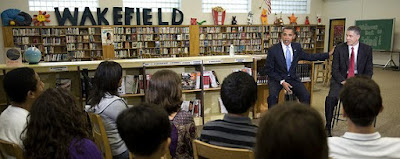
After the right wing raised a brouhaha over President Obama's speech to school kids, and after the White House dropped a phrase the right wing objected to (same phrase used by President HW Bush, about kids helping "the President"), the speech was reported on by all the various media outlets. The Wall Street Journal took its usual slant: Speech to Students Puts Politics Aside is the title of the article. The blurb on page one has it: the speech steered clear of politicking critics had warned about.
Well, it was never about politics, but about education. The critics had criticized something they did not know anything about; they would criticize anything, and everything, the President says and does.
slideshow
Text of Speech

After the right wing raised a brouhaha over President Obama's speech to school kids, and after the White House dropped a phrase the right wing objected to (same phrase used by President HW Bush, about kids helping "the President"), the speech was reported on by all the various media outlets. The Wall Street Journal took its usual slant: Speech to Students Puts Politics Aside is the title of the article. The blurb on page one has it: the speech steered clear of politicking critics had warned about.
Well, it was never about politics, but about education. The critics had criticized something they did not know anything about; they would criticize anything, and everything, the President says and does.
slideshow
Text of Speech
Monday, August 31, 2009
the Obama-Brooks romance

The Courtship
The story behind the Obama-Brooks bromance.
* Gabriel Sherman
* August 31, 2009 | 12:00 am
In the spring of 2005, New York Times columnist David Brooks arrived at then-Senator Barack Obama’s office for a chat. Brooks, a conservative writer who joined the Times in 2003 from The Weekly Standard, had never met Obama before. But, as they chewed over the finer points of Edmund Burke, it didn’t take long for the two men to click. “I don’t want to sound like I’m bragging,” Brooks recently told me, “but usually when I talk to senators, while they may know a policy area better than me, they generally don’t know political philosophy better than me. I got the sense he knew both better than me.”
That first encounter is still vivid in Brooks’s mind. “I remember distinctly an image of--we were sitting on his couches, and I was looking at his pant leg and his perfectly creased pant,” Brooks says, “and I’m thinking, a) he’s going to be president and b) he’ll be a very good president.” In the fall of 2006, two days after Obama’s The Audacity of Hope hit bookstores, Brooks published a glowing Times column. The headline was “Run, Barack, Run.”
These days, the center-right Brooks frequently seems more sympathetic toward Obama than the liberal Paul Krugman. He has written columns praising Obama’s Afghanistan policy, education proposals, and economic team. Even on broad areas of disagreement--deficit spending, the sprawling stimulus bill, health care reform--Brooks tends to treat Obama and his administration with respect. “My overall view,” Brooks told me, “is ninety-five percent of the decisions they make are good and intelligent. Whether I agree with them specifically, I think they’re very serious and very good at what they do.” It is an odd situation to say the least: David Brooks, prominent conservative, has become the most visible journalistic ally of arguably the most liberal president of his lifetime.
How did this happen? During the 1990s, Brooks was closely identified with national-greatness conservatism--a set of ideas that he touted in a widely discussed cover story for The Weekly Standard--which, in turn, was closely linked to the insurgent McCain campaign of 2000. But, whereas McCain and Bill Kristol (Brooks’s boss at The Weekly Standard) eventually put aside the bitterness of that primary contest and returned to the loyal Republican fold, Brooks has kept a certain distance from movement conservatism. “David is a conservative who is motivated by a deep distrust of ideology,” former Bush speechwriter Michael Gerson, a Brooks friend, says. “That is a strain of conservatism. It puts him in a position where he’s not taking views simply because they fit a party line.” Indeed, at Obama’s much-talked-about January dinner with conservative pundits--hosted by George Will and attended by CNBC’s Larry Kudlow, Washington Post columnist Charles Krauthammer, and Wall Street Journal editorial-page editor Paul Gigot, among others--the president greeted Brooks by asking, “What are you doing here?”
Brooks concedes that his place on the political spectrum has shifted somewhat over the years. “I used to think conservatives were right about the big things--the Soviet Union, economic growth,” he explains. “Now, on a lot of issues, I think liberals have been right about some big things, like rising inequality. Both sides of the education divide are within the Democratic Party. . . . The Republicans are sitting this one out. And, then, the war in Iraq has caused me to rethink things in a much more modest [way], and that is Burkean, too.”
He recognizes something similar in the current president. “Obama sees himself as a Burkean,” Brooks says. “He sees his view of the world as a view that understands complexity and the organic nature of change.” Moreover, after the Bush years, Brooks seems relieved to have an intellectual in the White House again. “I divide people into people who talk like us and who don’t talk like us,” he explains. “Of recent presidents, Clinton could sort of talk like us, but Obama is definitely--you could see him as a New Republic writer. He can do the jurisprudence, he can do the political philosophy, and he can do the politics. I think he’s more talented than anyone in
my lifetime. I mean, he is pretty dazzling when he walks into a room. So, that’s why it’s important he doesn’t fuck this up.”
White House officials have gone out of their way to cater to Brooks recently. Take Obama’s senior adviser, David Axelrod, whose career Brooks kept a close eye on after he graduated from the University of Chicago in 1983 and took a job at the City News Bureau, a Chicago wire service. At the time, Axelrod was the lead City Hall reporter for the Chicago Tribune. “I followed his career because he was who I wanted to be,” Brooks told me. “He was a hero.” The two finally crossed paths in 2004, when Axelrod was working for John Edwards. And, this April, as the keynote speaker at The Week magazine’s opinion awards ceremony--where Brooks was honored--Axelrod showered the columnist with praise, calling him a “serious public thinker” in an era of “insipid, instant commentary and one-hour news cycles.”
Last month, I met Brooks for lunch at Equinox, a few blocks north of the White House. That morning, he had published an unusually harsh column criticizing what he saw as Democratic overreach on health care and the stimulus. Already, he had heard from administration officials complaining about the piece. But “they’re always nice,” Brooks said, adding, “It’s never, ‘You’re a complete asshole.’My line is, the Clinton people would tell you you’re a complete and total asshole. The Obama people say, ‘We love you. You’re a great guy. It’s sad you’re a complete and total asshole.’ They’re always very mature about it.”
A similar thing happened in early March, when chief of staff Rahm Emanuel called Brooks to complain about that morning’s column criticizing Obama’s spending programs; later in the day, the White House sent over a chart showing that spending was, in fact, holding to historical norms. Brooks told me that Obama had personally signed the chart “Dear Comrade Brooks.” In June, The Washington Post reported that Emanuel had arranged for Obama to “drop by” a briefing Brooks attended. “I feel like I can call anybody,” Brooks says of his access to top White House officials such as Emanuel, Axelrod, and Office of Management and Budget head Peter Orszag. “With Bush, there were months when I was in favor, and months when I was out of favor. Here, you can write whatever you want; you don’t notice any diminution. If I call Rahm or Orszag or Axelrod, they’re happy to talk.”
Brooks isn’t blind to the fact that the White House goes out of its way to flatter him. This spring, he told Charlie Rose, “David Axelrod walks into a meeting with me, carrying the Reflections On The Revolution In France by Edmund Burke. They’re not without manipulation.” It’s easy to understand why the administration does this. Brooks’s sympathetic columns help to validate the key myth of this White House: that it is fundamentally post-partisan. Plus, Brooks appeals to a major Obama constituency: the latté-sipping Baby Boomers who were the subject of his 2000 best-seller Bobos in Paradise. These were among Obama’s strongest supporters in the last election, but their loyalty could be tested by spiraling deficits, botched health care reform, or a flagging economy.
As much as any columnist, Brooks speaks to these left-of-center suburbanites. After all, he is known for attracting liberal readers who normally can’t stand conservative pundits. “I get a lot of people who say, ‘I’m a liberal and you’re the only one I read,’ ” Brooks says. “Sometimes, it can be a little condescending. . . . But you take the readers where you can get them. I do wish more people walked up to me and said, ‘I’m a conservative and I love you.’ But, mostly, they don’t read the Times.”
Source URL: http://www.tnr.com/article/politics/the-courtship
Friday, August 7, 2009
The angry mob
Robert Gibbs, the White House press secretary, has compared the scenes at health care town halls to the “Brooks Brothers riot” in 2000 — the demonstration that disrupted the vote count in Miami and arguably helped send George W. Bush to the White House. Portrayed at the time as local protesters, many of the rioters were actually G.O.P. staffers flown in from Washington.
But Mr. Gibbs is probably only half right. Yes, well-heeled interest groups are helping to organize the town hall mobs. Key organizers include two Astroturf (fake grass-roots) organizations: FreedomWorks, run by the former House majority leader Dick Armey, and a new organization called Conservatives for Patients’ Rights.
The latter group, by the way, is run by Rick Scott, the former head of Columbia/HCA, a for-profit hospital chain. Mr. Scott was forced out of that job amid a fraud investigation; the company eventually pleaded guilty to charges of overbilling state and federal health plans, paying $1.7 billion — yes, that’s “billion” — in fines. You can’t make this stuff up.
These people have a vested interest in health care reform failing.
But while the organizers are as crass as they come, I haven’t seen any evidence that the people disrupting those town halls are Florida-style rent-a-mobs. For the most part, the protesters appear to be genuinely angry. The question is, what are they angry about?
About creeping socialism, many say. Limbaugh and Beck have called Obama's programs Mazi; fat Limbaugh compared the symbols of Obama's program to the Nazi symbol. Beck has called Obama a racist who hates "white culture" -- without defining what white culture is, leaving it for yahoos to translate white culture to whatever they want.
No one of those right wing zealots point out that Medicare, Medicais, Social Security and unemployment insurance are government-run programs (as are subsidies and tax deductions for home mortgages).
Now, people who don’t know that Medicare is a government program probably aren’t reacting to what President Obama is actually proposing. They may believe some of the disinformation opponents of health care reform are spreading, like the claim that the Obama plan will lead to euthanasia for the elderly. (That particular claim is coming straight from House Republican leaders.) But they’re probably reacting less to what Mr. Obama is doing, or even to what they’ve heard about what he’s doing, than to who he is.
Fears are being stoked by demagogues.
That is, the driving force behind the town hall mobs is probably the same cultural and racial anxiety that’s behind the “birther” movement, which denies Mr. Obama’s citizenship. Senator Dick Durbin has suggested that the birthers and the health care protesters are one and the same; we don’t know how many of the protesters are birthers, but it wouldn’t be surprising if it’s a substantial fraction.
Same mentality.
Does this sound familiar? It should: it’s a strategy that has played a central role in American politics ever since Richard Nixon realized that he could advance Republican fortunes by appealing to the racial fears of working-class whites.
Not just working-calss whites have racial fears.
Many people hoped that last year’s election would mark the end of the “angry white voter” era in America. Indeed, voters who can be swayed by appeals to cultural and racial fear are a declining share of the electorate.
But right now Mr. Obama’s backers seem to lack all conviction, perhaps because the prosaic reality of his administration isn’t living up to their dreams of transformation. Meanwhile, the angry right is filled with a passionate intensity.
And if Mr. Obama can’t recapture some of the passion of 2008, can’t inspire his supporters to stand up and be heard, health care reform may well fail.
Sadly.
But Mr. Gibbs is probably only half right. Yes, well-heeled interest groups are helping to organize the town hall mobs. Key organizers include two Astroturf (fake grass-roots) organizations: FreedomWorks, run by the former House majority leader Dick Armey, and a new organization called Conservatives for Patients’ Rights.
The latter group, by the way, is run by Rick Scott, the former head of Columbia/HCA, a for-profit hospital chain. Mr. Scott was forced out of that job amid a fraud investigation; the company eventually pleaded guilty to charges of overbilling state and federal health plans, paying $1.7 billion — yes, that’s “billion” — in fines. You can’t make this stuff up.
These people have a vested interest in health care reform failing.
But while the organizers are as crass as they come, I haven’t seen any evidence that the people disrupting those town halls are Florida-style rent-a-mobs. For the most part, the protesters appear to be genuinely angry. The question is, what are they angry about?
About creeping socialism, many say. Limbaugh and Beck have called Obama's programs Mazi; fat Limbaugh compared the symbols of Obama's program to the Nazi symbol. Beck has called Obama a racist who hates "white culture" -- without defining what white culture is, leaving it for yahoos to translate white culture to whatever they want.
No one of those right wing zealots point out that Medicare, Medicais, Social Security and unemployment insurance are government-run programs (as are subsidies and tax deductions for home mortgages).
Now, people who don’t know that Medicare is a government program probably aren’t reacting to what President Obama is actually proposing. They may believe some of the disinformation opponents of health care reform are spreading, like the claim that the Obama plan will lead to euthanasia for the elderly. (That particular claim is coming straight from House Republican leaders.) But they’re probably reacting less to what Mr. Obama is doing, or even to what they’ve heard about what he’s doing, than to who he is.
Fears are being stoked by demagogues.
That is, the driving force behind the town hall mobs is probably the same cultural and racial anxiety that’s behind the “birther” movement, which denies Mr. Obama’s citizenship. Senator Dick Durbin has suggested that the birthers and the health care protesters are one and the same; we don’t know how many of the protesters are birthers, but it wouldn’t be surprising if it’s a substantial fraction.
Same mentality.
Does this sound familiar? It should: it’s a strategy that has played a central role in American politics ever since Richard Nixon realized that he could advance Republican fortunes by appealing to the racial fears of working-class whites.
Not just working-calss whites have racial fears.
Many people hoped that last year’s election would mark the end of the “angry white voter” era in America. Indeed, voters who can be swayed by appeals to cultural and racial fear are a declining share of the electorate.
But right now Mr. Obama’s backers seem to lack all conviction, perhaps because the prosaic reality of his administration isn’t living up to their dreams of transformation. Meanwhile, the angry right is filled with a passionate intensity.
And if Mr. Obama can’t recapture some of the passion of 2008, can’t inspire his supporters to stand up and be heard, health care reform may well fail.
Sadly.
Saturday, July 11, 2009
What Happened in Vegas
Collins is spot-on, again.
The reason the Republicans lost so many Senate seats last November is now becoming clear. No one had any time to think about the campaign. They were too busy worrying about Senator John Ensign’s sex life.
Nobody paid a great deal of attention. Really, there are only so many randy Republicans we can keep track of at once. But lately, the Ensign saga has become more and more fascinating. Every social conservative in Washington seems to have been involved.
That's an interesting point: the Republicans seem over-sexed, the very same party that espouses (pun intended) family values as a centerpiece of its mission statement.
Ensign was, at the time, chairman of the National Republican Senatorial Committee, which was supposed to be working to elect candidates in 2008. In Washington, he lived with some other conservative Christian lawmakers in a building known as the “Prayer House.” Both members of the N.R.S.C. and residents of the Prayer House were brought into the drama. Hampton, in his version of events, seems to remember Ensign’s friends as being particularly concerned with making sure that the cuckolded aide got generous compensation for his suffering.
Hampton is the wronged husband of the woman whom Senator Ensign pursued, and caught, and literally did to the same thing he figuratively did to the husband, his constituents, and the country at large.
One of Ensign’s roommates, Senator Tom Coburn of Oklahoma, was described by Hampton as being particularly vocal about the importance of cash contributions to “make these folks whole.” Coburn denies this, although he won’t say exactly what advice he gave to his erring colleague. Coburn told Roll Call that he talked to Ensign as a “physician and as an ordained deacon” and that he will therefore have the right to keep mum even if he’s dragged into court or a Senate committee hearing.
This makes me sort of hope that some kind of investigation takes place just so Coburn, who’s an obstetrician, can explain how exactly doctor-patient confidentiality figures into this.
Zing.
We hardly need to point out that Ensign was one of the people who demanded that President Bill Clinton resign over the Lewinsky affair, that he votes against financing for education and contraception services to combat teenage pregnancy and that he supports a constitutional amendment banning same-sex marriage. In the world of politics, hypocrisy is a hard market to corner, but lately the Republicans have been making a Microsoft-like effort to do it.
Actually, we do need to point out their hypocrisy.
Both of the Hamptons lost their jobs, and Doug was shuttled off to a Las Vegas-based airline, run by a friend of Ensign’s, where he is now vice president of government affairs. Unappeased, he hired a lawyer to demand that Ensign make financial amends for “evil and completely unjustifiable acts by one of our country’s top leaders.” He also tried to leak the story of the affair to Fox News, apparently under the theory that out of all the media, Fox would be most excited by the opportunity to humiliate a powerful conservative Republican senator.
Fair and balanced, right?
Truly, this puts a whole new spin on the term “family values.”
The reason the Republicans lost so many Senate seats last November is now becoming clear. No one had any time to think about the campaign. They were too busy worrying about Senator John Ensign’s sex life.
Nobody paid a great deal of attention. Really, there are only so many randy Republicans we can keep track of at once. But lately, the Ensign saga has become more and more fascinating. Every social conservative in Washington seems to have been involved.
That's an interesting point: the Republicans seem over-sexed, the very same party that espouses (pun intended) family values as a centerpiece of its mission statement.
Ensign was, at the time, chairman of the National Republican Senatorial Committee, which was supposed to be working to elect candidates in 2008. In Washington, he lived with some other conservative Christian lawmakers in a building known as the “Prayer House.” Both members of the N.R.S.C. and residents of the Prayer House were brought into the drama. Hampton, in his version of events, seems to remember Ensign’s friends as being particularly concerned with making sure that the cuckolded aide got generous compensation for his suffering.
Hampton is the wronged husband of the woman whom Senator Ensign pursued, and caught, and literally did to the same thing he figuratively did to the husband, his constituents, and the country at large.
One of Ensign’s roommates, Senator Tom Coburn of Oklahoma, was described by Hampton as being particularly vocal about the importance of cash contributions to “make these folks whole.” Coburn denies this, although he won’t say exactly what advice he gave to his erring colleague. Coburn told Roll Call that he talked to Ensign as a “physician and as an ordained deacon” and that he will therefore have the right to keep mum even if he’s dragged into court or a Senate committee hearing.
This makes me sort of hope that some kind of investigation takes place just so Coburn, who’s an obstetrician, can explain how exactly doctor-patient confidentiality figures into this.
Zing.
We hardly need to point out that Ensign was one of the people who demanded that President Bill Clinton resign over the Lewinsky affair, that he votes against financing for education and contraception services to combat teenage pregnancy and that he supports a constitutional amendment banning same-sex marriage. In the world of politics, hypocrisy is a hard market to corner, but lately the Republicans have been making a Microsoft-like effort to do it.
Actually, we do need to point out their hypocrisy.
Both of the Hamptons lost their jobs, and Doug was shuttled off to a Las Vegas-based airline, run by a friend of Ensign’s, where he is now vice president of government affairs. Unappeased, he hired a lawyer to demand that Ensign make financial amends for “evil and completely unjustifiable acts by one of our country’s top leaders.” He also tried to leak the story of the affair to Fox News, apparently under the theory that out of all the media, Fox would be most excited by the opportunity to humiliate a powerful conservative Republican senator.
Fair and balanced, right?
Truly, this puts a whole new spin on the term “family values.”
Friday, July 10, 2009
Family values
This jerk's picture should appear in the dictionary next to the word tawdry. And his room-mate should be a footnote.
Sen. John Ensign has put a new spin on family values. The Las Vegas Republican, 51, enlisted his elderly parents to pay out $96,00 in "gifts" to his ex-mistress and her family. His father, Mike, is a wealthy casino mogul.
Mighty suspicious gifts.
Lest anyone think it was hush money, his lawyer Paul Coggins insisted, "Ensign has complied with all applicable laws and Senate ethics rules."
Those ethics rules need some revamping, as does the Senator's morality.
A statement from Ensign's office said that "his parents decided to make the gifts out of concern for the well-being of long-time family friends during a difficult time."
Difficult time, alright.
"The gifts are consistent with a pattern of generosity by the Ensign family to the Hamptons and others," it continued.
Nice people.
In addition to getting help from dear old dad, Ensign received some life-coaching from fellow Sen. Tom Coburn. Coburn counseled Ensign to end the affair, but he denied helping draft the the breakup letter Ensign wrote to Cindy Hampton. "I was never present when the letter was written."
Not present when the letter was written does not exclude Senator Coburn from having participated in discussions about, or the drafting of, said letter.
Coburn refused to say what he told Ensign to do, noting that he was both a medical doctor and an "ordained deacon," and such information was "privileged communication."
Amen.
Sen. John Ensign has put a new spin on family values. The Las Vegas Republican, 51, enlisted his elderly parents to pay out $96,00 in "gifts" to his ex-mistress and her family. His father, Mike, is a wealthy casino mogul.
Mighty suspicious gifts.
Lest anyone think it was hush money, his lawyer Paul Coggins insisted, "Ensign has complied with all applicable laws and Senate ethics rules."
Those ethics rules need some revamping, as does the Senator's morality.
A statement from Ensign's office said that "his parents decided to make the gifts out of concern for the well-being of long-time family friends during a difficult time."
Difficult time, alright.
"The gifts are consistent with a pattern of generosity by the Ensign family to the Hamptons and others," it continued.
Nice people.
In addition to getting help from dear old dad, Ensign received some life-coaching from fellow Sen. Tom Coburn. Coburn counseled Ensign to end the affair, but he denied helping draft the the breakup letter Ensign wrote to Cindy Hampton. "I was never present when the letter was written."
Not present when the letter was written does not exclude Senator Coburn from having participated in discussions about, or the drafting of, said letter.
Coburn refused to say what he told Ensign to do, noting that he was both a medical doctor and an "ordained deacon," and such information was "privileged communication."
Amen.
Wednesday, July 1, 2009
Pressure Grows for Sanford to Resign
He is falling off the edge.
Calls are growing among Republicans for love-struck South Carolina Gov. Mark Sanford to resign. As of Tueday night, 10 conservative Republican state senators had called for Sanford, who admitted an extramarital affair last week and added more details. Tuesday, to step aside. Until Sanford’s trip last month to Argentina to visit his girlfriend, the governor had been considered a rising GOP star.
He has fallen hard, far and fast.
In a letter late Tuesday, six lawmakers wrote: “The bottom line is that the Governor’s private matters should remain private, but his deception and negligence make it impossible for us to trust him, and for him to govern in the future.” Senate Majority Leader Harvey Peeler, who initiated the letter, raised questions about his mental state. “There’s just no way he’ll be able to continue as governor,” he said, expressing concerns about Sanford’s accounts of his extramarital activities. “I’m really concerned about his mental well being.”
Maybe his private matters should remain private, but he keeps confessing to a longer list of sins. And he seems to be unhinged.
Peeler told CNN that the governor “has lost his ability to lead, and I’m afraid he has lost his ability to function as a man. He is sitting all alone in that big governor’s mansion, totally alone,” Peeler continued. “It’s about leadership and moving forward and it’s time for him to resign.”
He really seems lost.
Hugh Leatherman, Thomas Alexander, Paul Campbell, Jake Knotts, Larry Martin and William O’Dell also signed the letter. Earlier, GOP state Sen. Larry Grooms said the governor has “lost the moral authority to lead our state, so he needs to step down for the good of our state.”
This morning, U.S. Sen. Jim DeMint, a South Carolina Republican, didn’t call for Sanford’s resignation, but suggested we stay tuned. “Mark and I are good friends and good friends with Jenny. It’s tragic for their family. It’s very bad for our state,” he said in an interview with Fox News. “We have high unemployment — a lot of challenges, right now, and we need strong leadership. So this comes at a very bad time.”
Well, what would have been a good time for the Governor to 'fess up to cheatin' on his wife and family repeatedly?
DeMint said Sanford had “dropped the flag” for the conservative movement, adding: “The rest of us have to get up and go on. A lot of us are talking to him behind the scenes in hopes that he’ll make the right decision about what needs to be done.”
Dropped the conservative flag? How about the religious, moral and marital?
Another story details the Guv's dalliances, and his gamble.
After days of assuring the public he was firmly in control after admitting a scandalous affair, South Carolina Gov. Mark Sanford detailed other encounters with his Argentine "soul mate," dalliances with women before her, and his struggle to salvage his 20-year marriage.
"I don't want to blow up my time in politics," he told the AP. "I don't want to blow up future earning power, I don't want to blow up the kids' lives. I don't want to blow up 20 years that we've invested. But if I'm completely honest, there are still feelings in the way. If we keep pushing it this way, we get those to die off, but they're still there and they're still real."
His logic is twisted, reflecting his mental state.
He insists he can fall back in love with his wife, Jenny, even as he witnesses his "own political funeral." Sanford detailed more encounters with his mistress than he had disclosed during a rambling, emotional news conference last week. The new revelations Tuesday led the state attorney general to launch an investigation of Sanford's travels to check on taxpayer money.
He's out of control. Poor kids.
Calls are growing among Republicans for love-struck South Carolina Gov. Mark Sanford to resign. As of Tueday night, 10 conservative Republican state senators had called for Sanford, who admitted an extramarital affair last week and added more details. Tuesday, to step aside. Until Sanford’s trip last month to Argentina to visit his girlfriend, the governor had been considered a rising GOP star.
He has fallen hard, far and fast.
In a letter late Tuesday, six lawmakers wrote: “The bottom line is that the Governor’s private matters should remain private, but his deception and negligence make it impossible for us to trust him, and for him to govern in the future.” Senate Majority Leader Harvey Peeler, who initiated the letter, raised questions about his mental state. “There’s just no way he’ll be able to continue as governor,” he said, expressing concerns about Sanford’s accounts of his extramarital activities. “I’m really concerned about his mental well being.”
Maybe his private matters should remain private, but he keeps confessing to a longer list of sins. And he seems to be unhinged.
Peeler told CNN that the governor “has lost his ability to lead, and I’m afraid he has lost his ability to function as a man. He is sitting all alone in that big governor’s mansion, totally alone,” Peeler continued. “It’s about leadership and moving forward and it’s time for him to resign.”
He really seems lost.
Hugh Leatherman, Thomas Alexander, Paul Campbell, Jake Knotts, Larry Martin and William O’Dell also signed the letter. Earlier, GOP state Sen. Larry Grooms said the governor has “lost the moral authority to lead our state, so he needs to step down for the good of our state.”
This morning, U.S. Sen. Jim DeMint, a South Carolina Republican, didn’t call for Sanford’s resignation, but suggested we stay tuned. “Mark and I are good friends and good friends with Jenny. It’s tragic for their family. It’s very bad for our state,” he said in an interview with Fox News. “We have high unemployment — a lot of challenges, right now, and we need strong leadership. So this comes at a very bad time.”
Well, what would have been a good time for the Governor to 'fess up to cheatin' on his wife and family repeatedly?
DeMint said Sanford had “dropped the flag” for the conservative movement, adding: “The rest of us have to get up and go on. A lot of us are talking to him behind the scenes in hopes that he’ll make the right decision about what needs to be done.”
Dropped the conservative flag? How about the religious, moral and marital?
Another story details the Guv's dalliances, and his gamble.
After days of assuring the public he was firmly in control after admitting a scandalous affair, South Carolina Gov. Mark Sanford detailed other encounters with his Argentine "soul mate," dalliances with women before her, and his struggle to salvage his 20-year marriage.
"I don't want to blow up my time in politics," he told the AP. "I don't want to blow up future earning power, I don't want to blow up the kids' lives. I don't want to blow up 20 years that we've invested. But if I'm completely honest, there are still feelings in the way. If we keep pushing it this way, we get those to die off, but they're still there and they're still real."
His logic is twisted, reflecting his mental state.
He insists he can fall back in love with his wife, Jenny, even as he witnesses his "own political funeral." Sanford detailed more encounters with his mistress than he had disclosed during a rambling, emotional news conference last week. The new revelations Tuesday led the state attorney general to launch an investigation of Sanford's travels to check on taxpayer money.
He's out of control. Poor kids.
Friday, June 26, 2009
Holding Firm Against Plots by Evildoers
Research files at the John Birch Society headquarters in Grand Chute, Wis.

On a buzzing boulevard in this busy shopping town, across from a supermarket and not far from a PetSmart, there sits a building that might be mistaken for a place where you can have your teeth cleaned, were it not for the name affixed to the brick: The John Birch Society.
YOur teeth, maybe not; your brain, definitely.
For some, that name means nothing. Or it sparks flashbacks to the 1960s, when the John Birch Society was synonymous with seeing red here, there and everywhere. Maybe you displayed a Birch bumper sticker on your car; maybe you enjoyed the Chad Mitchell Trio song mocking the Birch obsession with communism:
You cannot trust your neighbor or even next of kin
If mommy is a commie then you gotta turn her in.
Yet for others, the John Birch Society is urgently relevant to the matters of today, in its support of secure borders and limited government, its distrust of the Federal Reserve and the United Nations, and its belief in a conspiracy to merge Mexico, Canada and the United States.
They must have a black-helicopter-spotter on duty 24 hours a day.
This so-called North American Union, it asserts, is part of a larger plot by an amorphous, amoral group of powerful elite — including but not limited to the Council on Foreign Relations, the Trilateral Commission and the Rockefellers — to take over planet Earth. Call it the New World Order.
Well, the Trilateral Commission is composed of about 325 members: 170 European, 120 North American (20 Canadian members, 13 Mexican members and 87 U.S. members), 100 Pacific Asian (Japan, Korea, Australia, New Zealand, ASEAN nations, and, beginning recently, the Commission recently began admitting members from China and India. Rockefellers? Wrong century.
Some of these theories may sound like cable television chatter, or the synopsis of a Dan Brown bestseller. But Birch leaders say this plot is real, with roots going back more than 200 years to a secret, insidious brotherhood called the Illuminati, and with most American presidents among its many dupes and abettors.
George W. Bush a dupe? Nah!
The John Birch Society — whose name honors a missionary and American intelligence officer killed by Chinese communists in 1945 — still holds meetings in living rooms and public libraries. But it also maintains a handsome Web site that invites the curious to download literature and join a chapter. (“Click here to find like-minded people.”)
Libraries?
 Audio Slide Show Inside the John Birch Society

On a buzzing boulevard in this busy shopping town, across from a supermarket and not far from a PetSmart, there sits a building that might be mistaken for a place where you can have your teeth cleaned, were it not for the name affixed to the brick: The John Birch Society.
YOur teeth, maybe not; your brain, definitely.
For some, that name means nothing. Or it sparks flashbacks to the 1960s, when the John Birch Society was synonymous with seeing red here, there and everywhere. Maybe you displayed a Birch bumper sticker on your car; maybe you enjoyed the Chad Mitchell Trio song mocking the Birch obsession with communism:
You cannot trust your neighbor or even next of kin
If mommy is a commie then you gotta turn her in.
Yet for others, the John Birch Society is urgently relevant to the matters of today, in its support of secure borders and limited government, its distrust of the Federal Reserve and the United Nations, and its belief in a conspiracy to merge Mexico, Canada and the United States.
They must have a black-helicopter-spotter on duty 24 hours a day.
This so-called North American Union, it asserts, is part of a larger plot by an amorphous, amoral group of powerful elite — including but not limited to the Council on Foreign Relations, the Trilateral Commission and the Rockefellers — to take over planet Earth. Call it the New World Order.
Well, the Trilateral Commission is composed of about 325 members: 170 European, 120 North American (20 Canadian members, 13 Mexican members and 87 U.S. members), 100 Pacific Asian (Japan, Korea, Australia, New Zealand, ASEAN nations, and, beginning recently, the Commission recently began admitting members from China and India. Rockefellers? Wrong century.
Some of these theories may sound like cable television chatter, or the synopsis of a Dan Brown bestseller. But Birch leaders say this plot is real, with roots going back more than 200 years to a secret, insidious brotherhood called the Illuminati, and with most American presidents among its many dupes and abettors.
George W. Bush a dupe? Nah!
The John Birch Society — whose name honors a missionary and American intelligence officer killed by Chinese communists in 1945 — still holds meetings in living rooms and public libraries. But it also maintains a handsome Web site that invites the curious to download literature and join a chapter. (“Click here to find like-minded people.”)
Libraries?
Multimedia
Audio Slide Show Inside the John Birch Society
Sunday, June 21, 2009
Can't he do everything?
Obama under pressure: There will always be a fly in the ointment for Obama
by Susan Nielsen, The Oregonian Sunday June 21, 2009, 12:03 am
 You can hear a faint buzz of dismay any time President Obama falls to behave precisely like a liberal superhero.
Leave it to a fatly buzzing fly to embody the peskiest part of President Obama's job: No matter what the president does, the media will overplay it and someone will find fault with it.
I agree with this columnist, entirely. I've been feeling much the same way recently: now that the president has been in office for five months, liberals are complaining that he isn't doing what they expect of him, the way they expect him to do it. How quickly some forget how it was to have a righ-wing republican in office instead of middle-to-left moderate-liberal, the latter much more likely to do things that will please liberals than the former ever was or would be.
This leaves self-described independents, who now make up the majority of the electorate, with the tough job of assessing Obama fairly as politics heat up and expectations for an economic recovery intensify.
by Susan Nielsen, The Oregonian Sunday June 21, 2009, 12:03 am
 You can hear a faint buzz of dismay any time President Obama falls to behave precisely like a liberal superhero.
 Leave it to a fatly buzzing fly to embody the peskiest part of President Obama's job: No matter what the president does, the media will overplay it and someone will find fault with it.
I agree with this columnist, entirely. I've been feeling much the same way recently: now that the president has been in office for five months, liberals are complaining that he isn't doing what they expect of him, the way they expect him to do it. How quickly some forget how it was to have a righ-wing republican in office instead of middle-to-left moderate-liberal, the latter much more likely to do things that will please liberals than the former ever was or would be.
This leaves self-described independents, who now make up the majority of the electorate, with the tough job of assessing Obama fairly as politics heat up and expectations for an economic recovery intensify.
First, a quick recap of Flygate. The cable news network CNBC interrupted its more serious coverage last week to air a long clip of Obama killing a bothersome fly with a single dispassionate slap. Along the bottom of the screen crawled this headline: "BREAKING NEWS: PRES. OBAMA SWATS FLY DURING CNBC INTERVIEW AT WHITE HOUSE."
Is there any doubt that media outlets concentrate on the trivial?
The group People for the Ethical Treatment of Animals swiftly reproached the president. While conceding Obama's impeccable record on animal rights, the activists said he should set a better example and vowed to send him a Katcha Bug Humane Bug Catcher.
Oy.
Picture the laughs heard 'round the world if Obama strapped a bug catcher to his belt, next to his Blackberry. Now imagine the snorts of derision if the president -- the same man trying to be tough on North Korea -- couldn't manage a show of force against a fly.
The fly incident is only the silliest example of backbiting. Civil rights groups glower that Obama isn't in lockstep with them on Guantanamo detainees. Gay-rights groups fume that Obama did not include health benefits last week when he extended, by executive order, partnership benefits to gay federal workers.
They want their way, and only their way.
Never mind that Obama's trying to untangle a mess at Guantanamo without making new ones. Never mind that he supports extending these health benefits; he simply believes the change should happen through Congress rather than by executive fiat.
Which is the correct way to do it, contrary to what the previous administration was wont to do.
So Obama gives 90 percent and gets chided for falling short of 110. That's politics.
Dummies. They should consider the alternative.
Meanwhile, critics on the right pin the entire federal deficit on Obama, capitalizing on voters' growing concerns about government debt. The critics buzz around, complaining about turtle tunnels in Florida and other pork projects in the stimulus bill. They grouse that Obama has been too busy nationalizing the auto industry to do much to create or save jobs.
Double dummies. All the right wing is doing is pointing to what isn't happening, gnawing at the margins, and trying to create issues, knowing how to play to the media (the same outfits that covered Flygate).
Again, it's fair to call up the truth squad.
Just think how desperate Oregon and Washington would be without the federal stimulus money, which Obama got through Congress within a few weeks of taking office. Picture unemployment and poverty rising yet higher if countless additional teachers and other state workers had lost their jobs.
As bad as things are now, they're a picnic compared to life without the extra stimulus money, aka deficit spending. This money is keeping us from spiraling into a second Great Depression.
Speaking of deficits, The New York Times recently analyzed the $2trillion swing from the Clinton-era surpluses to today's deficits, using budget numbers and official projections from 2001 through 2012. The recession itself accounts for more than one-third of the shift. Policies from the Bush era, including tax cuts, new Medicare drug coverage, the Iraq war and the bank bailout, account for more than half of the shift.
The stimulus bill accounts for just 7 percent.
Even if it were more, it is what is needed to be done.
Obama's agenda on health care, climate change and education? Just 3 percent. (That's assuming Congress finds ways to pay for most new programs, always a big "if" no matter who's in charge.)
Obama's approval ratings remain high. The guy doesn't need defending. The public still trusts him enough to be patient, even as the job outlook stays bleak.
Still, our patience will wear thin eventually. As the debts of the past come due, we'll be tempted to blame Obama for the entire cost rather than admit complicity over the years.
Then we'll start needling Obama to fix the deficit without cutting any programs, raising taxes or touching entitlement spending. Meanwhile, we'll expect the president to solve North Korea, Iran and Afghanistan in his spare time.
Whatever the task, the eye of the camera will never go away.
Neither will the irritable buzz of the nearest and smallest fly.
-- Associate Editor Susan Nielsen, The Oregonian; susannielsen@news.oregonian.com
Saturday, June 6, 2009
Judicial 'Activism' Isn't the Issue
The writer works for a "libertarian public interest law firm." He contends that both liberals and conservatives are prejudiced in favor of the government to begin with, so that the judicial battles waged are over arcana.
The practical result is that judges of both persuasions almost never enforce any constitutional limit on the power of government to regulate property and the economy. Given that the vast majority of law concerns these two areas, the real crisis in constitutional law is not judicial "activism" but judicial passivism.
It all began in the late 1930s, when the Supreme Court opened the floodgates for New Deal economic regulation. In essence, conservatives have adopted the big-government agenda of that era. The liberal-conservative consensus explains why nomination fights focus on a few "culture war" issues such as gay marriage or guns. Liberals and conservatives squabble over these esoteric questions because there is such harmonious accord on everything else.
Whether blaming the 1930s Court is valid is debatable; the Court declared invalid at least some of FDR's programs. Yet the point that nomination fights over the last couple of decades have focused on "cultural" issues is valid.
His article meanders off on a discussion of libertarian objections to governmental power unchecked even by the Court.
Special interests love licensing because it restricts competition and thus drives up the prices they can charge. None of this would be possible if judges simply struck down licensing laws as an insult to the constitutional right to earn an honest living secured by the due process clause of the Fifth Amendment and the "privileges or immunities" clause of the 14th Amendment.
Judges should be neither active nor passive, neither aggressive nor deferential. In a word, they should be engaged -- engaged in protecting constitutional rights to property and economic liberty, because these areas of the law have the most impact on our daily lives.
The practical result is that judges of both persuasions almost never enforce any constitutional limit on the power of government to regulate property and the economy. Given that the vast majority of law concerns these two areas, the real crisis in constitutional law is not judicial "activism" but judicial passivism.
It all began in the late 1930s, when the Supreme Court opened the floodgates for New Deal economic regulation. In essence, conservatives have adopted the big-government agenda of that era. The liberal-conservative consensus explains why nomination fights focus on a few "culture war" issues such as gay marriage or guns. Liberals and conservatives squabble over these esoteric questions because there is such harmonious accord on everything else.
Whether blaming the 1930s Court is valid is debatable; the Court declared invalid at least some of FDR's programs. Yet the point that nomination fights over the last couple of decades have focused on "cultural" issues is valid.
His article meanders off on a discussion of libertarian objections to governmental power unchecked even by the Court.
Special interests love licensing because it restricts competition and thus drives up the prices they can charge. None of this would be possible if judges simply struck down licensing laws as an insult to the constitutional right to earn an honest living secured by the due process clause of the Fifth Amendment and the "privileges or immunities" clause of the 14th Amendment.
Judges should be neither active nor passive, neither aggressive nor deferential. In a word, they should be engaged -- engaged in protecting constitutional rights to property and economic liberty, because these areas of the law have the most impact on our daily lives.
Friday, May 29, 2009
Sotomayor’s Tongue and Temperament
This issue is part of the spaghetti-on-the-fridge approach: throw out as many as you can, and see what sticks. A red herring: any diversion intended to distract attention from the main issue.
To supporters, Judge Sotomayor’s vigorous questioning of the Bush administration’s position in the case of the Canadian, Maher Arar, showcases some of her strengths. She is known as a formidably intelligent judge with a prodigious memory who meticulously prepares for oral arguments and is not shy about grilling the lawyers who appear before her to ensure that she fully understands their arguments.
Sounds good.
But to detractors, Judge Sotomayor’s sharp-tongued and occasionally combative manner — some lawyers have described her as “difficult” and “nasty” — raises questions about her judicial temperament and willingness to listen. Her demeanor on the bench is an issue that conservatives opposed to her nomination see as a potential vulnerability — and one that Mr. Obama carefully considered before selecting her.
A man would be called assertive, and praised.
Judge Sotomayor’s colleagues on the United States Court of Appeals for the Second Circuit say her tough and direct questioning reflects engagement and, sometimes, an effort to persuade her colleagues. Those qualities, coupled with a gregarious personality, they said, make her a powerful force behind the scenes, where she has used her mastery of the cases to change minds, improve opinions and forge consensus.
Being nasty is a minus? Who compalined? Lawyers whose feeligns were hurt? C'mon.
Those skills, some observers say, could make her an able politician on the Supreme Court and allow her to serve as an intellectual counterweight to Justice Antonin Scalia, a conservative who is known for his acerbic questioning.
Ah, yes, acerbic. Is Scalia criticized for his temperament? No, conservatives sing his praises.
“In some ways she could match, well, the other New Yorker on the court, Justice Scalia,” said Douglas Kmiec, a law professor at Pepperdine University. “He expects people to give back as good as he gives, and I expect that when Justice Sotomayor is on the court, his wish will be fulfilled.”
There you go.
“They call it a hot bench when a judge asks a lawyer a lot of questions — well, she isn’t afraid of running a hot bench,” said H. Raymond Fasano, a Republican immigration lawyer who has appeared before her 24 times, mostly in asylum cases, and is a fan. “When a judge asks a lot of questions, that means she’s read the record, she knows the issues and she has concerns that she wants resolved. And that’s the judge’s job.”
Who expects the judge to be a pushover? Judges are supposed to guard the integrity of the law and to run a fair courtroom, not to pander and meander.
Judge Guido Calabresi, a former dean of Yale Law School who taught Ms. Sotomayor there and now sits with her on the Second Circuit, said complaints that she had been unduly caustic had no basis. For a time, Judge Calabresi said, he kept track of the questions posed by Judge Sotomayor and other members of the 12-member court. “Her behavior was identical,” he said.
“Some lawyers just don’t like to be questioned by a woman,” Judge Calabresi added. “It was sexist, plain and simple.”
He said Judge Sotomayor’s forceful and lucid arguments had persuaded him to reconsider his position in a number of instances. “And I’m a tough act,” he said.
Other colleagues said Judge Sotomayor frequently sent unusually detailed, closely reasoned and helpful memorandums critiquing their draft opinions. “She will offer substantive suggestions,” said Judge Jon O. Newman, “but she will not be tenacious in making sure the language comes out exactly her way.”
Laurence H. Tribe, a Harvard law professor who served as an adviser in the process that led to Judge Sotomayor’s selection for the Supreme Court, said the White House had found concerns about her temperament unfounded, concluding instead that her background and her concern with the consequences of court rulings would be a “healthy antidote” to more formalist legal theories advocated by the Supreme Court’s conservative wing.
And the right wing does not like that.
To supporters, Judge Sotomayor’s vigorous questioning of the Bush administration’s position in the case of the Canadian, Maher Arar, showcases some of her strengths. She is known as a formidably intelligent judge with a prodigious memory who meticulously prepares for oral arguments and is not shy about grilling the lawyers who appear before her to ensure that she fully understands their arguments.
Sounds good.
But to detractors, Judge Sotomayor’s sharp-tongued and occasionally combative manner — some lawyers have described her as “difficult” and “nasty” — raises questions about her judicial temperament and willingness to listen. Her demeanor on the bench is an issue that conservatives opposed to her nomination see as a potential vulnerability — and one that Mr. Obama carefully considered before selecting her.
A man would be called assertive, and praised.
Judge Sotomayor’s colleagues on the United States Court of Appeals for the Second Circuit say her tough and direct questioning reflects engagement and, sometimes, an effort to persuade her colleagues. Those qualities, coupled with a gregarious personality, they said, make her a powerful force behind the scenes, where she has used her mastery of the cases to change minds, improve opinions and forge consensus.
Being nasty is a minus? Who compalined? Lawyers whose feeligns were hurt? C'mon.
Those skills, some observers say, could make her an able politician on the Supreme Court and allow her to serve as an intellectual counterweight to Justice Antonin Scalia, a conservative who is known for his acerbic questioning.
Ah, yes, acerbic. Is Scalia criticized for his temperament? No, conservatives sing his praises.
“In some ways she could match, well, the other New Yorker on the court, Justice Scalia,” said Douglas Kmiec, a law professor at Pepperdine University. “He expects people to give back as good as he gives, and I expect that when Justice Sotomayor is on the court, his wish will be fulfilled.”
There you go.
“They call it a hot bench when a judge asks a lawyer a lot of questions — well, she isn’t afraid of running a hot bench,” said H. Raymond Fasano, a Republican immigration lawyer who has appeared before her 24 times, mostly in asylum cases, and is a fan. “When a judge asks a lot of questions, that means she’s read the record, she knows the issues and she has concerns that she wants resolved. And that’s the judge’s job.”
Who expects the judge to be a pushover? Judges are supposed to guard the integrity of the law and to run a fair courtroom, not to pander and meander.
Judge Guido Calabresi, a former dean of Yale Law School who taught Ms. Sotomayor there and now sits with her on the Second Circuit, said complaints that she had been unduly caustic had no basis. For a time, Judge Calabresi said, he kept track of the questions posed by Judge Sotomayor and other members of the 12-member court. “Her behavior was identical,” he said.
“Some lawyers just don’t like to be questioned by a woman,” Judge Calabresi added. “It was sexist, plain and simple.”
He said Judge Sotomayor’s forceful and lucid arguments had persuaded him to reconsider his position in a number of instances. “And I’m a tough act,” he said.
Other colleagues said Judge Sotomayor frequently sent unusually detailed, closely reasoned and helpful memorandums critiquing their draft opinions. “She will offer substantive suggestions,” said Judge Jon O. Newman, “but she will not be tenacious in making sure the language comes out exactly her way.”
Laurence H. Tribe, a Harvard law professor who served as an adviser in the process that led to Judge Sotomayor’s selection for the Supreme Court, said the White House had found concerns about her temperament unfounded, concluding instead that her background and her concern with the consequences of court rulings would be a “healthy antidote” to more formalist legal theories advocated by the Supreme Court’s conservative wing.
And the right wing does not like that.
Subscribe to:
Posts (Atom)