A right-wing columnist at the Journal, Daniel Henninger, had the temerity to use that headline in his screed. In his usual way, he bashes lefties, Obama and every President in the last century (he does not exclude Reagan).
The left-wing critics are right: The rage is not about health care. They are also right that similar complaints about big government were heard during the New Deal and the Great Society, and the sky didn't fall. But what if this time the sky is falling—on them. What if after more than a century of growth in the national government, starting with the Progressive Era, the American people are starting to push back. Not just the tea partiers or the 13 state attorneys general seeking protection under the 10th Amendment and the Commerce Clause. But something bigger than that.
The rage is a tempest in a teapot that Republicans are trying to ride, to control, and to use as a substitute for a party platform that includes more than the word NO. Fringe and marginal people are organizing themselves into mobs and rabble that hold signs equating the President with Hitler, scream Socialism, dress up as Colinials in a Hollywood depiction of 1776, and have the temerity to hold flags that say Don't tread on me. These yahoos can manage to equate themselves with Colonials rebelling against taxation without representation. They are disaffected, lost, clueless, and otherwise idiotic. And Henninger throws in his two cents worth of lunacy.
Who are the American people that he so shamelessly assumes he can quote? Ten percent of the population? Twenty five? What about the rest of us?
Amendment 10 - Powers of the States and People. Ratified 12/15/1791. The powers not delegated to the United States by the Constitution, nor prohibited by it to the States, are reserved to the States respectively, or to the people.
The Attorneys General who sued the federal government are, save one, all Republicans. All of them would love to get enough publicity to ride a wave of popularity to higher office.
The American people can and do change the nation's collective mind on the ordering of our political system. The civil rights years of the 1960s is the most well-known modern example. (The idea that resistance to Mr. Obama's health plan is rooted in racist resentment of equal rights is beyond the pale, even by current standards of political punditry.)
He uses the civil rights struggle to legitimize his extremism, shamelessly. He is completely wrong. That struggle was fought by individuals banded together in a movement to end overt racism, legitimate and legal discrimination, and a century of racial animus sanctified by law. His tea parties are not close to being in the same league.
Faced with corporate writedowns in response to the reality of Congress's new health plan, an apoplectic Congressman Henry Waxman commanded his economic vassals to appear before him in Washington.
These corporate writedowns priovided Henninger and his crowd of prevaricators and liers an opportunity to again twist fatcs for their own purpose. A story has some of the details: The legislation prevents companies from deducting tax-free subsidies they receive from the government for providing prescription-drug benefits to retirees. The charges are noncash, meaning companies won't have to write a check, but ultimately their tax bills will be higher without a change in tax treatment of the drug-benefit subsidy, assuming their benefits don't change. The health-care overhaul doesn't eliminate the subsidy, but starting in 2013, companies can no longer deduct the part of the benefit that is paid for by the subsidies.
A non-cash charge, or an acounting entry, is all. And what is being changed is: companies were given a subsidy, and allowed to deduct that subsidy from their taxes. That was unfair, and is being ended.
Faced with a challenge to his vision last week, President Obama laughingly replied to these people: "Go for it." They will. As to the condescension and sniffing left-wing elitism this opposition seems to bring forth from Manhattan media castles, one must say it does recall another, earlier ancien regime.
Wonder if the Manhattan media castles he sniffes against include News Corp's?
Showing posts with label Media. Show all posts
Showing posts with label Media. Show all posts
Thursday, April 1, 2010


Tuesday, January 5, 2010
New Focus on an Odd Spot
National Archives/Reuters - 'SICK MAN AT YALTA' During the cold war, detractors claimed that Stalin took advantage of Roosevelt's ill health at the Allied conference in 1945, just before the president died.

When President Franklin D. Roosevelt died unexpectedly on April 12, 1945, in Warm Springs, Ga., the White House lost no time announcing a cause of death.
The 63-year-old president, the shocked and grieving nation was told, had died of cerebral hemorrhage. (“Last Words,” read a front-page headline in The New York Times: “ ‘I Have a Terrific Headache.’ ”)
That Roosevelt died of a stroke is undisputed. But what caused it is a medical mystery that has persisted to this day, a mystery heightened by the secrecy in which he, his aides and his doctors always insisted on shrouding his health.
Now a new book — “F.D.R.’s Deadly Secret,” by a neurologist, Dr. Steven Lomazow, and a journalist, Eric Fettmann (PublicAffairs) — revives an intriguing theory. Look closely at Roosevelt’s portraits over his 12-year presidency. In his first two terms, there is a dark spot over his left eyebrow. It seems to grow and then mysteriously vanishes sometime around 1940, leaving a small scar.
Was the spot a harmless mole? Or a cancerous melanoma that spread to contribute to, or even cause, his death? Melanomas, after all, are known for causing strokes from bleeding when they spread to the brain. This hypothesis is not new.

Tracking F.D.R’s Mole
The speculation about a melanoma cannot be verified because there was no autopsy and no known biopsy, and most of Roosevelt’s medical records disappeared shortly after his death from a safe in the United States Naval Hospital in Bethesda, Md.
Disappeared? Or were made to disappear?
Even in the 1940s, some Washington insiders claimed that Roosevelt knew he was seriously ill, if not dying, when he ran for his final term, and that was one of the reasons he dumped his vice president, Henry A. Wallace, from the Democratic ticket in favor of Harry S. Truman. But most historians say he picked Truman for political reasons, not for his qualifications.

When President Franklin D. Roosevelt died unexpectedly on April 12, 1945, in Warm Springs, Ga., the White House lost no time announcing a cause of death.
The 63-year-old president, the shocked and grieving nation was told, had died of cerebral hemorrhage. (“Last Words,” read a front-page headline in The New York Times: “ ‘I Have a Terrific Headache.’ ”)
That Roosevelt died of a stroke is undisputed. But what caused it is a medical mystery that has persisted to this day, a mystery heightened by the secrecy in which he, his aides and his doctors always insisted on shrouding his health.
Now a new book — “F.D.R.’s Deadly Secret,” by a neurologist, Dr. Steven Lomazow, and a journalist, Eric Fettmann (PublicAffairs) — revives an intriguing theory. Look closely at Roosevelt’s portraits over his 12-year presidency. In his first two terms, there is a dark spot over his left eyebrow. It seems to grow and then mysteriously vanishes sometime around 1940, leaving a small scar.
Was the spot a harmless mole? Or a cancerous melanoma that spread to contribute to, or even cause, his death? Melanomas, after all, are known for causing strokes from bleeding when they spread to the brain. This hypothesis is not new.
Tracking F.D.R’s Mole
The speculation about a melanoma cannot be verified because there was no autopsy and no known biopsy, and most of Roosevelt’s medical records disappeared shortly after his death from a safe in the United States Naval Hospital in Bethesda, Md.
Disappeared? Or were made to disappear?
Even in the 1940s, some Washington insiders claimed that Roosevelt knew he was seriously ill, if not dying, when he ran for his final term, and that was one of the reasons he dumped his vice president, Henry A. Wallace, from the Democratic ticket in favor of Harry S. Truman. But most historians say he picked Truman for political reasons, not for his qualifications.
Wednesday, December 30, 2009
Momentum lost
President Obama seems to have lost momentum. The health care bill passed the Senate, in an ugly fashion (though that is how politics works, more often than not the sausage-making process is done behind closed doors, so the public is spared the ugliness of legislative reality). The climate summit in Copenhagen was not a great success, and seemed a waste of time. And now the underwear bomber has thrown the Administration on the defensive.
A couple of days ago Leslie Gelb wrote a piece warning President Obama against the Jimmy Carter-presidency syndrome. It well analyzes the drift of the Obama presidency. For one, I have been amazed at the start of the 2010 campaign: it kicked off on Wednesday 5 November, 2008, and again on January 21, 2009. And the Administration has never been in charge. Republicans have blustered, rode tea parties, said no over and over, and although they have not accomplished much, neither has the President.
Don’t be fooled by the year-end reprieve of President Obama because the economy looks a bit brighter and the Senate passed a health bill. He’s been pummeled hard all along the political spectrum. He’s in trouble. If he doesn’t overhaul himself and his administration quickly, right-wing bizarros will control Congress in 2011 and he’ll be looking for another job in 2013. He’ll end up a one-termer like Jimmy Carter and George H. W. Bush. Obama can’t afford to wait to make a mid-course correction a year from now. He’s got to make a quarter-course correction in the next months. He needs to prioritize and focus his energies on the economy, teach his opponents to fear him, and change some top personnel. Above all, he’s got to modify his own ways. He puts far too much store on being the smartest guy in the room and not enough on experience. He’d do well to remember that Jimmy Carter also rang all the IQ bells.
Gelb is not an alarmist. Someone should talk to the President.
Maureen Dowd ain't happy neither; she can be inconsistent, a bit quick off the mark, but she is very sharp, and not just with her pen. In an op-ed piece today, she makes her opinion quite clear.
I was walking through a deserted downtown on Christmas Eve with a friend, past the lonely, gray Treasury Building, past the snowy White House with no president inside.
“I hope the terrorists don’t think this is a good time to attack,” I said, looking protectively at the White House, which always looks smaller and more vulnerable and beautiful than you expect, no matter how often you see it up close. I thought our guard might be down because of the holiday; now I realize our guard is down every day.
Not reassuring, or reassured, is she.
W.’s favorite word was “resolute,” but despite gazillions spent and Cheney’s bluster, our efforts to shield ourselves seemed flaccid.
Flaccid; interesting choice of word.
President Obama’s favorite word is “unprecedented,” as Carol Lee of Politico pointed out. Yet he often seems mired in the past as well, letting his hallmark legislation get loaded up with old-school bribes and pork; surrounding himself with Clintonites; continuing the Bushies’ penchant for secrecy and expansive executive privilege; doubling down in Afghanistan while acting as though he’s getting out; and failing to capitalize on snazzy new technology while agencies thumb through printouts and continue their old turf battles.
Aside from many speeches, and the health care bill he basically allowed Congress to devise (not a bad decision in itself), there certainly hasn't been much change. Of course, it needs to be pointed out that he is getting little push from his own party. And that is amazing in itself: the Democrats won the presidency, have a majority in the House, have 58 votes in the Senate, and yet seem unable to make things work. If the Republicans had 58 votes in the Senate, they would be passing legislation right and, well, right and center. Hell, with only 40 votes, they show solidarity, and unity. The Democrats are fractious, bumbling, and unequal to the challenge.
If we can’t catch a Nigerian with a powerful explosive powder in his oddly feminine-looking underpants and a syringe full of acid, a man whose own father had alerted the U.S. Embassy in Nigeria, a traveler whose ticket was paid for in cash and who didn’t check bags, whose visa renewal had been denied by the British, who had studied Arabic in Al Qaeda sanctuary Yemen, whose name was on a counterterrorism watch list, who can we catch?
Now that he is President, this is his responsibility, and this breakdown his fault.
Before he left for vacation, Obama tried to shed his Spock mien and juice up the empathy quotient on jobs. But in his usual inspiring/listless cycle, he once more appeared chilly in his response to the chilling episode on Flight 253, issuing bulletins through his press secretary and hitting the links. At least you have to seem concerned.
I haven't followed it closely, but I must say that today my support for the President is flaccid. He never loses his cool, and getting a little pissed off seems right

The Daily News, no longer a right-wing bastion, is equally punishing of the President: It's time to get serious, Obama! The president uncharacteristically lacked a sense of urgency in his address of Umar Farouk Abdulmutallab's failed bombing of Flight 253.
Uncharacteristically might not be the correct word.
The attempt to blow Northwest Flight 253 out of the air was planned as an attack on the United States and very nearly succeeded in accomplishing that horrific goal. The moment demanded inspiring, decisive presidential leadership.
America waited four days for a glimmer.
President Obama's initial response Monday was too long in coming, too cool in delivery and too removed from the extreme gravity of the plot.
Not a good mark, no B+ this time.
Obama's description of Abdulmutallab as an "isolated extremist" was remarkable and disturbing. This radicalized young Nigerian is nothing of the sort. He operated, in fact, as an Al Qaeda-recruited, Al Qaeda-supplied, Al Qaeda-directed foot soldier - as, to put it directly, an enemy combatant, and not as the criminal "suspect" of Obama's description.
And Republicans will not miss or tire in taking advantage of this opportunity served up to them on a political platter by Secretary Napolitano and President Obama.
Ultimately, Obama will be measured by a single, unforgiving standard of accountability. It will not be that he affords constitutional rights to terrorists. It will not be that he distinguishes himself by 180 degrees from his predecessor. It will not be that he extends a hand to the Muslim world and refrains from speaking of Islamist terror. It will be whether, on his watch, America suffers a terror attack from abroad, as almost happened on Christmas.
A couple of days ago Leslie Gelb wrote a piece warning President Obama against the Jimmy Carter-presidency syndrome. It well analyzes the drift of the Obama presidency. For one, I have been amazed at the start of the 2010 campaign: it kicked off on Wednesday 5 November, 2008, and again on January 21, 2009. And the Administration has never been in charge. Republicans have blustered, rode tea parties, said no over and over, and although they have not accomplished much, neither has the President.
Don’t be fooled by the year-end reprieve of President Obama because the economy looks a bit brighter and the Senate passed a health bill. He’s been pummeled hard all along the political spectrum. He’s in trouble. If he doesn’t overhaul himself and his administration quickly, right-wing bizarros will control Congress in 2011 and he’ll be looking for another job in 2013. He’ll end up a one-termer like Jimmy Carter and George H. W. Bush. Obama can’t afford to wait to make a mid-course correction a year from now. He’s got to make a quarter-course correction in the next months. He needs to prioritize and focus his energies on the economy, teach his opponents to fear him, and change some top personnel. Above all, he’s got to modify his own ways. He puts far too much store on being the smartest guy in the room and not enough on experience. He’d do well to remember that Jimmy Carter also rang all the IQ bells.
Gelb is not an alarmist. Someone should talk to the President.
Maureen Dowd ain't happy neither; she can be inconsistent, a bit quick off the mark, but she is very sharp, and not just with her pen. In an op-ed piece today, she makes her opinion quite clear.
I was walking through a deserted downtown on Christmas Eve with a friend, past the lonely, gray Treasury Building, past the snowy White House with no president inside.
“I hope the terrorists don’t think this is a good time to attack,” I said, looking protectively at the White House, which always looks smaller and more vulnerable and beautiful than you expect, no matter how often you see it up close. I thought our guard might be down because of the holiday; now I realize our guard is down every day.
Not reassuring, or reassured, is she.
W.’s favorite word was “resolute,” but despite gazillions spent and Cheney’s bluster, our efforts to shield ourselves seemed flaccid.
Flaccid; interesting choice of word.
President Obama’s favorite word is “unprecedented,” as Carol Lee of Politico pointed out. Yet he often seems mired in the past as well, letting his hallmark legislation get loaded up with old-school bribes and pork; surrounding himself with Clintonites; continuing the Bushies’ penchant for secrecy and expansive executive privilege; doubling down in Afghanistan while acting as though he’s getting out; and failing to capitalize on snazzy new technology while agencies thumb through printouts and continue their old turf battles.
Aside from many speeches, and the health care bill he basically allowed Congress to devise (not a bad decision in itself), there certainly hasn't been much change. Of course, it needs to be pointed out that he is getting little push from his own party. And that is amazing in itself: the Democrats won the presidency, have a majority in the House, have 58 votes in the Senate, and yet seem unable to make things work. If the Republicans had 58 votes in the Senate, they would be passing legislation right and, well, right and center. Hell, with only 40 votes, they show solidarity, and unity. The Democrats are fractious, bumbling, and unequal to the challenge.
If we can’t catch a Nigerian with a powerful explosive powder in his oddly feminine-looking underpants and a syringe full of acid, a man whose own father had alerted the U.S. Embassy in Nigeria, a traveler whose ticket was paid for in cash and who didn’t check bags, whose visa renewal had been denied by the British, who had studied Arabic in Al Qaeda sanctuary Yemen, whose name was on a counterterrorism watch list, who can we catch?
Now that he is President, this is his responsibility, and this breakdown his fault.
Before he left for vacation, Obama tried to shed his Spock mien and juice up the empathy quotient on jobs. But in his usual inspiring/listless cycle, he once more appeared chilly in his response to the chilling episode on Flight 253, issuing bulletins through his press secretary and hitting the links. At least you have to seem concerned.
I haven't followed it closely, but I must say that today my support for the President is flaccid. He never loses his cool, and getting a little pissed off seems right

The Daily News, no longer a right-wing bastion, is equally punishing of the President: It's time to get serious, Obama! The president uncharacteristically lacked a sense of urgency in his address of Umar Farouk Abdulmutallab's failed bombing of Flight 253.
Uncharacteristically might not be the correct word.
The attempt to blow Northwest Flight 253 out of the air was planned as an attack on the United States and very nearly succeeded in accomplishing that horrific goal. The moment demanded inspiring, decisive presidential leadership.
America waited four days for a glimmer.
President Obama's initial response Monday was too long in coming, too cool in delivery and too removed from the extreme gravity of the plot.
Not a good mark, no B+ this time.
Obama's description of Abdulmutallab as an "isolated extremist" was remarkable and disturbing. This radicalized young Nigerian is nothing of the sort. He operated, in fact, as an Al Qaeda-recruited, Al Qaeda-supplied, Al Qaeda-directed foot soldier - as, to put it directly, an enemy combatant, and not as the criminal "suspect" of Obama's description.
And Republicans will not miss or tire in taking advantage of this opportunity served up to them on a political platter by Secretary Napolitano and President Obama.
Ultimately, Obama will be measured by a single, unforgiving standard of accountability. It will not be that he affords constitutional rights to terrorists. It will not be that he distinguishes himself by 180 degrees from his predecessor. It will not be that he extends a hand to the Muslim world and refrains from speaking of Islamist terror. It will be whether, on his watch, America suffers a terror attack from abroad, as almost happened on Christmas.
Tuesday, December 15, 2009
Waking Up Serious Instead of Silly
 George Stephanopoulos
 Not that I watch morning teevee, but I like George a great deal, have gotten to like Charlie Gibson, and have never liked Diane Sawyer (she worked in the Nixon White House). I shall miss Charlie.
ABC News hopes that its anchor shakeup will help close its ratings gap with NBC News, but new faces are not necessarily a guarantee of success: the anointment of Katie Couric as the first solo female network anchor has not budged CBS’s evening news out of a distant third place.
Despite ever-dwindling audiences, network news programs cling to established formula and cookie-cutter formats. Changes in personnel don’t radically alter the program, but personality does have an effect on its content.
Monday, December 14, 2009
Under Murdoch, tilting rightward
Rupert Murdoch, a lifelong conservative, addressing the newsroom at The Wall Street Journal two years ago, when he took over.

Not that the Wall Street Journal was a leftists rag and needed a push to the right; if anything, they were a perfect match.
Glenn R. Simpson, who left the newspaper back in March, is not a fan of the newsier, less analytical Journal.
“Murdoch didn’t ruin The Wall Street Journal; he just rendered it into a much more ordinary paper,” he said.
But there are growing indications that Mr. Murdoch, a lifelong conservative, doesn’t just want to cover politics, he wants to play them as well.
He has always played politics. Perhaps he is becoming less covert, but the change is of style, not substance.
According to several former members of the Washington bureau and two current ones, the two men have had a big impact on the paper’s Washington coverage, adopting a more conservative tone, and editing and headlining articles to reflect a chronic skepticism of the current administration. And given that the paper’s circulation continues to grow, albeit helped along by some discounts, there’s nothing to suggest that The Journal’s readers don’t approve.
More conservative? I don't notice the change; the paper was always conservative. And subscribing to the paper does not equate to approving of its politics.
In response to questions about bias in the newspaper, a Journal spokesman sent along the following statement: “The Journal has always provided its readers with unique, objective news reporting from our Washington Bureau.”
Oy. Fair and balanced?
Tension between Washington bureaus and headquarters is a common feature of newspapers, and none of the people I spoke to suggested that either Mr. Thomson or Mr. Baker lacked savvy as journalists or leaders — only that ideology was baked into the coverage through headlines, assignments and editing in a way that had never occurred in the past.

Not that the Wall Street Journal was a leftists rag and needed a push to the right; if anything, they were a perfect match.
Glenn R. Simpson, who left the newspaper back in March, is not a fan of the newsier, less analytical Journal.
“Murdoch didn’t ruin The Wall Street Journal; he just rendered it into a much more ordinary paper,” he said.
But there are growing indications that Mr. Murdoch, a lifelong conservative, doesn’t just want to cover politics, he wants to play them as well.
He has always played politics. Perhaps he is becoming less covert, but the change is of style, not substance.
According to several former members of the Washington bureau and two current ones, the two men have had a big impact on the paper’s Washington coverage, adopting a more conservative tone, and editing and headlining articles to reflect a chronic skepticism of the current administration. And given that the paper’s circulation continues to grow, albeit helped along by some discounts, there’s nothing to suggest that The Journal’s readers don’t approve.
More conservative? I don't notice the change; the paper was always conservative. And subscribing to the paper does not equate to approving of its politics.
In response to questions about bias in the newspaper, a Journal spokesman sent along the following statement: “The Journal has always provided its readers with unique, objective news reporting from our Washington Bureau.”
Oy. Fair and balanced?
Tension between Washington bureaus and headquarters is a common feature of newspapers, and none of the people I spoke to suggested that either Mr. Thomson or Mr. Baker lacked savvy as journalists or leaders — only that ideology was baked into the coverage through headlines, assignments and editing in a way that had never occurred in the past.
Saturday, November 28, 2009
Uninvited
Samantha Appleton/The White House - In a photo released by the White House, President Obama greeted Michaele and Tareq Salahi, right, at his first state dinner on Tuesday.

O, boy, does the media love this story!
President Obama and his wife, Michelle, had a face-to-face encounter with the couple who sneaked into a state dinner at the White House this week, White House officials acknowledged on Friday. The revelation underscored the seriousness of the security breach and prompted an abject apology from the Secret Service.
A White House spokesman said that the couple, Michaele and Tareq Salahi of Virginia, met and shook hands with the president and the first lady in the receiving line in the Blue Room, as the Obamas greeted each of their 400 invited guests Tuesday night before moving to a tent on the South Lawn for dinner.
Of course, this is serious: uninvited guests got into a White House fête with, perhaps, a combination of guile and charm on their part (aspiring reality teevee people that they are, all the better for them), and security breakdown on the Secret Service's part (disastrous public relations, and serious implications for the security of the President and the WHite House: if the WH itself can be penetrated, what is safe?).
That disclosure coincided with a statement from the director of the Secret Service, Mark Sullivan, saying that his agency was “deeply concerned and embarrassed” by the events. Secret Service officials said the agency wanted to interview everyone connected with the episode, including the Salahis, and had not ruled out criminal charges.
Filing criminal charges seems a way to get even, but would amount to more free publicity for the couple, and could well backfire in the face of the Secret Service.
Related
The TV Watch: For Some, a Search for Celebrity Is Worth Any Risk (November 28, 2009)
Obamas’ Uninvited Guests Prompt an Inquiry (November 27, 2009)
For their part, White House officials took pains to publicly refrain from criticizing the Secret Service. “The men and women of the Secret Service put their lives on the line every day to protect us; they are heroes, and they have the full confidence of the president of United States,” said Nick Shapiro, a White House spokesman.
Heroes? They do perform hazardous duty, but heroes? Heroes are those who perform extraordinarily, and are "distinguished by exceptional courage and nobility and strength." These days the word hero is bandied about too often and dropped far too easily.

O, boy, does the media love this story!
President Obama and his wife, Michelle, had a face-to-face encounter with the couple who sneaked into a state dinner at the White House this week, White House officials acknowledged on Friday. The revelation underscored the seriousness of the security breach and prompted an abject apology from the Secret Service.
A White House spokesman said that the couple, Michaele and Tareq Salahi of Virginia, met and shook hands with the president and the first lady in the receiving line in the Blue Room, as the Obamas greeted each of their 400 invited guests Tuesday night before moving to a tent on the South Lawn for dinner.
Of course, this is serious: uninvited guests got into a White House fête with, perhaps, a combination of guile and charm on their part (aspiring reality teevee people that they are, all the better for them), and security breakdown on the Secret Service's part (disastrous public relations, and serious implications for the security of the President and the WHite House: if the WH itself can be penetrated, what is safe?).
That disclosure coincided with a statement from the director of the Secret Service, Mark Sullivan, saying that his agency was “deeply concerned and embarrassed” by the events. Secret Service officials said the agency wanted to interview everyone connected with the episode, including the Salahis, and had not ruled out criminal charges.
Filing criminal charges seems a way to get even, but would amount to more free publicity for the couple, and could well backfire in the face of the Secret Service.
Related
The TV Watch: For Some, a Search for Celebrity Is Worth Any Risk (November 28, 2009)
Obamas’ Uninvited Guests Prompt an Inquiry (November 27, 2009)
For their part, White House officials took pains to publicly refrain from criticizing the Secret Service. “The men and women of the Secret Service put their lives on the line every day to protect us; they are heroes, and they have the full confidence of the president of United States,” said Nick Shapiro, a White House spokesman.
Heroes? They do perform hazardous duty, but heroes? Heroes are those who perform extraordinarily, and are "distinguished by exceptional courage and nobility and strength." These days the word hero is bandied about too often and dropped far too easily.
Wednesday, November 25, 2009
Dooffus
Lou Dobbs, speaking with Bill O’Reilly of Fox News.

Doofus: dimwit.
People take this jerk seriously?
A spokesman for Mr. Dobbs said he was seriously considering a race in 2012 against Senator Robert Menendez of New Jersey, above, as “an intermediary step.”

Intermediary? Another dim bulb. Intermediary is a go-between; surely the spokes-jerk meant intermediate. Spare us, Yahweh.
he told a Washington radio station, “For the first time, I’m actually listening to some people about politics,” adding: “I think that being in the public arena means you’ve got to be part of the solution.”
Really? there are scads of people in the public arena who are nothing more than part of the problem.

Doofus: dimwit.
People take this jerk seriously?
A spokesman for Mr. Dobbs said he was seriously considering a race in 2012 against Senator Robert Menendez of New Jersey, above, as “an intermediary step.”

Intermediary? Another dim bulb. Intermediary is a go-between; surely the spokes-jerk meant intermediate. Spare us, Yahweh.
he told a Washington radio station, “For the first time, I’m actually listening to some people about politics,” adding: “I think that being in the public arena means you’ve got to be part of the solution.”
Really? there are scads of people in the public arena who are nothing more than part of the problem.
Tuesday, November 24, 2009
Fear not the vaccine
 El secretario de Salud dijo que la inmunización contra el virus A H1n1 es confiable | Ver nota
That is a lot of media.
Wednesday, September 16, 2009
Carter’s Racism Charge Sparks War of Words
Perhaps only Jimmy Carter has the nerve to be as blunt as this; his blunt comments on Israeli apartheid drew similarly passionate reactions.
Former President Jimmy Carter’s view that some of the recent protests against President Obama, including the “You Lie!” outburst by Representative Joe Wilson last week, are “based on racism,” has fueled a new war of words over this already charged issue.
The former president first weighed in on Tuesday during a question-and-answer session at the Carter Center in Atlanta. Mr. Carter responded to a question about Mr. Wilson’s eruption by saying that he did believe it was laced with racism. Coupling the Wilson remark with the images in recent weeks of angry demonstrators wielding signs depicting Mr. Obama as a Nazi or as Adolf Hitler, Mr. Carter said: “There is an inherent feeling among many in this country that an African-American should not be president.”
I agree with him, and not always, but I see the racism.
He lamented the tone of disrespect toward the current president, adding: “Those kind of things are not just casual outcomes of a sincere debate on whether we should have a national program on health care. It’s deeper than that.”
The rancor against the person, the fundamental questioning of his legitimacy, the labeling him a socialist, a Nazi, un-American, it all smacks of hatred of the person, and it is quite disturbing. Perhaps the rancor against Bush went too far, too, but his legitimacy wasn't questioned (other, of course, than his winning the 2000 election because of the Supreme Court's decision, itself a topic for debate).
Mr. Carter’s criticisms drew a sharp response from Michael Steele, the African-American chairman of the Republican party, who called the remarks an “outrage.” In a statement, Mr. Steele said: “President Carter is flat out wrong. This isn’t about race. It is about policy. This is a pathetic distraction by Democrats to shift attention away from the president’s wildly unpopular government-run health care plan that the American people simply oppose. Injecting race into the debate over critical issues facing American families doesn’t create jobs, reform our health care system or reduce the growing deficit. It only divides Americans rather than uniting us to find solutions to challenges facing our nation.”
Carter isn't wrong. It is not the ex-President who injected race into the public domain. And the President's health care plan is not "wildly unpopular" nor is it a government-run health care plan.
By stepping into the debate in such an explicit way, Mr. Carter used labels that the White House and others have clearly tried to avoid in the wake of Mr. Wilson’s remarks and last weekend’s angry demonstration on the Washington Mall. White House aides and some lawmakers had earlier deflected or dismissed questions centered on whether a racially tinged prism was underfoot, in what seemed a concerted effort to try to stay above the fray.
Above the fray? Race is a subject no one has the nerve to discuss openly, for too many people could get offended.
In a television interview on Sunday, Mr. Wilson, who was officially rebuked by the House on Tuesday, dismissed suggestions that his actions were racially motivated. One of his sons sprung to his defense after Mr. Carter’s remarks were publicized, saying his father didn’t have a “racist bone” in his body.
No one is a racist. There is no racism. We live in a racial Eden. The White House will not approach it openly, for it would be political dynamite, and would draw attention away from policies.
Other prominent officials however, like Representative James Clyburn, the Democratic majority whip from Mr. Wilson’s home state, have publicly implored the White House to directly confront what they view as an unseemly element aimed at, in Mr. Clyburn’s words “delegitimizing” the president. Don’t let it fester, he warned.
There are many people who do not accept President Obama's legitimacy, or even his citizenship. Black skin, a Muslim name.
Nearly all agree that the level of hostility aimed at Mr. Obama runs extremely high. Mr. Hoyer termed it unusually harsh. Some attribute part of the volume to the 24/7, Web-and-cable news driven world that we live in. Mr. Hoyer also noted policy divisions, including those who are also angered by how their tax dollars are being used, given the bank and auto bailouts by the government.
What would have been the alternative? And President Bush was not charged with being a socialist.
Former President Jimmy Carter’s view that some of the recent protests against President Obama, including the “You Lie!” outburst by Representative Joe Wilson last week, are “based on racism,” has fueled a new war of words over this already charged issue.
The former president first weighed in on Tuesday during a question-and-answer session at the Carter Center in Atlanta. Mr. Carter responded to a question about Mr. Wilson’s eruption by saying that he did believe it was laced with racism. Coupling the Wilson remark with the images in recent weeks of angry demonstrators wielding signs depicting Mr. Obama as a Nazi or as Adolf Hitler, Mr. Carter said: “There is an inherent feeling among many in this country that an African-American should not be president.”
I agree with him, and not always, but I see the racism.
He lamented the tone of disrespect toward the current president, adding: “Those kind of things are not just casual outcomes of a sincere debate on whether we should have a national program on health care. It’s deeper than that.”
The rancor against the person, the fundamental questioning of his legitimacy, the labeling him a socialist, a Nazi, un-American, it all smacks of hatred of the person, and it is quite disturbing. Perhaps the rancor against Bush went too far, too, but his legitimacy wasn't questioned (other, of course, than his winning the 2000 election because of the Supreme Court's decision, itself a topic for debate).
Visit msnbc.com for Breaking News, World News, and News about the Economy
Mr. Carter’s criticisms drew a sharp response from Michael Steele, the African-American chairman of the Republican party, who called the remarks an “outrage.” In a statement, Mr. Steele said: “President Carter is flat out wrong. This isn’t about race. It is about policy. This is a pathetic distraction by Democrats to shift attention away from the president’s wildly unpopular government-run health care plan that the American people simply oppose. Injecting race into the debate over critical issues facing American families doesn’t create jobs, reform our health care system or reduce the growing deficit. It only divides Americans rather than uniting us to find solutions to challenges facing our nation.”
Carter isn't wrong. It is not the ex-President who injected race into the public domain. And the President's health care plan is not "wildly unpopular" nor is it a government-run health care plan.
By stepping into the debate in such an explicit way, Mr. Carter used labels that the White House and others have clearly tried to avoid in the wake of Mr. Wilson’s remarks and last weekend’s angry demonstration on the Washington Mall. White House aides and some lawmakers had earlier deflected or dismissed questions centered on whether a racially tinged prism was underfoot, in what seemed a concerted effort to try to stay above the fray.
Above the fray? Race is a subject no one has the nerve to discuss openly, for too many people could get offended.
In a television interview on Sunday, Mr. Wilson, who was officially rebuked by the House on Tuesday, dismissed suggestions that his actions were racially motivated. One of his sons sprung to his defense after Mr. Carter’s remarks were publicized, saying his father didn’t have a “racist bone” in his body.
No one is a racist. There is no racism. We live in a racial Eden. The White House will not approach it openly, for it would be political dynamite, and would draw attention away from policies.
Other prominent officials however, like Representative James Clyburn, the Democratic majority whip from Mr. Wilson’s home state, have publicly implored the White House to directly confront what they view as an unseemly element aimed at, in Mr. Clyburn’s words “delegitimizing” the president. Don’t let it fester, he warned.
There are many people who do not accept President Obama's legitimacy, or even his citizenship. Black skin, a Muslim name.
Nearly all agree that the level of hostility aimed at Mr. Obama runs extremely high. Mr. Hoyer termed it unusually harsh. Some attribute part of the volume to the 24/7, Web-and-cable news driven world that we live in. Mr. Hoyer also noted policy divisions, including those who are also angered by how their tax dollars are being used, given the bank and auto bailouts by the government.
What would have been the alternative? And President Bush was not charged with being a socialist.
Wednesday, September 9, 2009
How are news reported?
President Barack Obama and Secretary of Education Arne Duncan (right) hold a discussion with 9th graders at Wakefield High School in Arlington, Va.
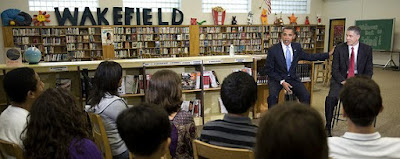
After the right wing raised a brouhaha over President Obama's speech to school kids, and after the White House dropped a phrase the right wing objected to (same phrase used by President HW Bush, about kids helping "the President"), the speech was reported on by all the various media outlets. The Wall Street Journal took its usual slant: Speech to Students Puts Politics Aside is the title of the article. The blurb on page one has it: the speech steered clear of politicking critics had warned about.
Well, it was never about politics, but about education. The critics had criticized something they did not know anything about; they would criticize anything, and everything, the President says and does.
slideshow
Text of Speech

After the right wing raised a brouhaha over President Obama's speech to school kids, and after the White House dropped a phrase the right wing objected to (same phrase used by President HW Bush, about kids helping "the President"), the speech was reported on by all the various media outlets. The Wall Street Journal took its usual slant: Speech to Students Puts Politics Aside is the title of the article. The blurb on page one has it: the speech steered clear of politicking critics had warned about.
Well, it was never about politics, but about education. The critics had criticized something they did not know anything about; they would criticize anything, and everything, the President says and does.
slideshow
Text of Speech
Monday, August 31, 2009
the Obama-Brooks romance

The Courtship
The story behind the Obama-Brooks bromance.
* Gabriel Sherman
* August 31, 2009 | 12:00 am
In the spring of 2005, New York Times columnist David Brooks arrived at then-Senator Barack Obama’s office for a chat. Brooks, a conservative writer who joined the Times in 2003 from The Weekly Standard, had never met Obama before. But, as they chewed over the finer points of Edmund Burke, it didn’t take long for the two men to click. “I don’t want to sound like I’m bragging,” Brooks recently told me, “but usually when I talk to senators, while they may know a policy area better than me, they generally don’t know political philosophy better than me. I got the sense he knew both better than me.”
That first encounter is still vivid in Brooks’s mind. “I remember distinctly an image of--we were sitting on his couches, and I was looking at his pant leg and his perfectly creased pant,” Brooks says, “and I’m thinking, a) he’s going to be president and b) he’ll be a very good president.” In the fall of 2006, two days after Obama’s The Audacity of Hope hit bookstores, Brooks published a glowing Times column. The headline was “Run, Barack, Run.”
These days, the center-right Brooks frequently seems more sympathetic toward Obama than the liberal Paul Krugman. He has written columns praising Obama’s Afghanistan policy, education proposals, and economic team. Even on broad areas of disagreement--deficit spending, the sprawling stimulus bill, health care reform--Brooks tends to treat Obama and his administration with respect. “My overall view,” Brooks told me, “is ninety-five percent of the decisions they make are good and intelligent. Whether I agree with them specifically, I think they’re very serious and very good at what they do.” It is an odd situation to say the least: David Brooks, prominent conservative, has become the most visible journalistic ally of arguably the most liberal president of his lifetime.
How did this happen? During the 1990s, Brooks was closely identified with national-greatness conservatism--a set of ideas that he touted in a widely discussed cover story for The Weekly Standard--which, in turn, was closely linked to the insurgent McCain campaign of 2000. But, whereas McCain and Bill Kristol (Brooks’s boss at The Weekly Standard) eventually put aside the bitterness of that primary contest and returned to the loyal Republican fold, Brooks has kept a certain distance from movement conservatism. “David is a conservative who is motivated by a deep distrust of ideology,” former Bush speechwriter Michael Gerson, a Brooks friend, says. “That is a strain of conservatism. It puts him in a position where he’s not taking views simply because they fit a party line.” Indeed, at Obama’s much-talked-about January dinner with conservative pundits--hosted by George Will and attended by CNBC’s Larry Kudlow, Washington Post columnist Charles Krauthammer, and Wall Street Journal editorial-page editor Paul Gigot, among others--the president greeted Brooks by asking, “What are you doing here?”
Brooks concedes that his place on the political spectrum has shifted somewhat over the years. “I used to think conservatives were right about the big things--the Soviet Union, economic growth,” he explains. “Now, on a lot of issues, I think liberals have been right about some big things, like rising inequality. Both sides of the education divide are within the Democratic Party. . . . The Republicans are sitting this one out. And, then, the war in Iraq has caused me to rethink things in a much more modest [way], and that is Burkean, too.”
He recognizes something similar in the current president. “Obama sees himself as a Burkean,” Brooks says. “He sees his view of the world as a view that understands complexity and the organic nature of change.” Moreover, after the Bush years, Brooks seems relieved to have an intellectual in the White House again. “I divide people into people who talk like us and who don’t talk like us,” he explains. “Of recent presidents, Clinton could sort of talk like us, but Obama is definitely--you could see him as a New Republic writer. He can do the jurisprudence, he can do the political philosophy, and he can do the politics. I think he’s more talented than anyone in
my lifetime. I mean, he is pretty dazzling when he walks into a room. So, that’s why it’s important he doesn’t fuck this up.”
White House officials have gone out of their way to cater to Brooks recently. Take Obama’s senior adviser, David Axelrod, whose career Brooks kept a close eye on after he graduated from the University of Chicago in 1983 and took a job at the City News Bureau, a Chicago wire service. At the time, Axelrod was the lead City Hall reporter for the Chicago Tribune. “I followed his career because he was who I wanted to be,” Brooks told me. “He was a hero.” The two finally crossed paths in 2004, when Axelrod was working for John Edwards. And, this April, as the keynote speaker at The Week magazine’s opinion awards ceremony--where Brooks was honored--Axelrod showered the columnist with praise, calling him a “serious public thinker” in an era of “insipid, instant commentary and one-hour news cycles.”
Last month, I met Brooks for lunch at Equinox, a few blocks north of the White House. That morning, he had published an unusually harsh column criticizing what he saw as Democratic overreach on health care and the stimulus. Already, he had heard from administration officials complaining about the piece. But “they’re always nice,” Brooks said, adding, “It’s never, ‘You’re a complete asshole.’My line is, the Clinton people would tell you you’re a complete and total asshole. The Obama people say, ‘We love you. You’re a great guy. It’s sad you’re a complete and total asshole.’ They’re always very mature about it.”
A similar thing happened in early March, when chief of staff Rahm Emanuel called Brooks to complain about that morning’s column criticizing Obama’s spending programs; later in the day, the White House sent over a chart showing that spending was, in fact, holding to historical norms. Brooks told me that Obama had personally signed the chart “Dear Comrade Brooks.” In June, The Washington Post reported that Emanuel had arranged for Obama to “drop by” a briefing Brooks attended. “I feel like I can call anybody,” Brooks says of his access to top White House officials such as Emanuel, Axelrod, and Office of Management and Budget head Peter Orszag. “With Bush, there were months when I was in favor, and months when I was out of favor. Here, you can write whatever you want; you don’t notice any diminution. If I call Rahm or Orszag or Axelrod, they’re happy to talk.”
Brooks isn’t blind to the fact that the White House goes out of its way to flatter him. This spring, he told Charlie Rose, “David Axelrod walks into a meeting with me, carrying the Reflections On The Revolution In France by Edmund Burke. They’re not without manipulation.” It’s easy to understand why the administration does this. Brooks’s sympathetic columns help to validate the key myth of this White House: that it is fundamentally post-partisan. Plus, Brooks appeals to a major Obama constituency: the latté-sipping Baby Boomers who were the subject of his 2000 best-seller Bobos in Paradise. These were among Obama’s strongest supporters in the last election, but their loyalty could be tested by spiraling deficits, botched health care reform, or a flagging economy.
As much as any columnist, Brooks speaks to these left-of-center suburbanites. After all, he is known for attracting liberal readers who normally can’t stand conservative pundits. “I get a lot of people who say, ‘I’m a liberal and you’re the only one I read,’ ” Brooks says. “Sometimes, it can be a little condescending. . . . But you take the readers where you can get them. I do wish more people walked up to me and said, ‘I’m a conservative and I love you.’ But, mostly, they don’t read the Times.”
Source URL: http://www.tnr.com/article/politics/the-courtship
Friday, August 14, 2009
Thursday, August 13, 2009
Clinton’s Flash of Pique in Congo
 Hillary Rodham Clinton in Africa
It was hot. She was tired. And it had been a long day in Africa.
And the media has made her remark the story. All the other things she has done have been buried under the trivial.
After the forum, her aides told the traveling press corps that there might have been a mistranslation, and that the student actually wanted to know the opinion of her boss, not her husband. But that interpretation did not dispel the controversy either, since it gave new life to the nagging question of whether Mrs. Clinton felt marginalized in the Obama administration.
Palace intrigue seems more important than substantive issues.
Her talk with the students had started out friendly enough, with questions about human rights and the environment. But it got a little edgy when several students pushed her on why Congo, whose first prime minister was ousted with the help of the C.I.A., should now trust the United States. She then became a little prickly.
the hubbub seemed to drain Mrs. Clinton. Until then, she had seemed impervious to the jet lag that was stalking her entourage from the moment they plopped down in Kenya. But on Tuesday, especially after meeting Congolese rape victims and touring a squalid refugee camp where thousands of people lived cheek by sunken cheek, Mrs. Clinton seemed enervated. Perhaps it was the sight of so many civilians suffering from a conflict the world has failed to stop. She said a few words on the plane ride back from Congo, but her language was not as emotional as it had been, or as urgent.
No matter the issues she was talking about — encouraging good governing, ending Africa’s wars, lifting women up from their lowly position in a place like Congo. The interest in this trip, it seemed, was not about the problems facing Africa. It was about her.
As one journalist covering her trip put it: “She is a celebrity. We have a celebrity secretary of state. When you have a celebrity, you get celebrity coverage.”
What does say about the media covering her? Nothing good about that media covering her.
Saturday, August 8, 2009
Inside The Great American Bubble Machine
An article from Rolling Stone magazine investigating and reporting on the power of Goldman Sachs,
Take a Chill Pill
You can’t channel surf on cable these days without seeing pundits who insist that: 1) Obama has over-learned the lessons of Clintoncare; 2) ceded too much power to Congress; and 3) blown it by not detailing what he wants in a final bill at this point. These folks don’t know what they’re talking about. The nattering nabobs of an earlier era would have likewise slammed Abraham Lincoln when he said, apropos of his general outlook, that “my policy is to have no policy.” But Lincoln knew a thing or two about political leadership. Within general parameters (pro-slavery or anti-slavery, pro-health reform or anti-health reform), a president’s job is to preserve enough flexibility to get the results he seeks while carrying most of the people along with him. A studied ambiguity as events unfold is indispensable to this task, and Obama intuits this just right.
Take a Chill Pill
by Matt Miller
August 6, 2009 | 10:57pm
No matter what the critics say, health-care reform isn’t in trouble yet. The Daily Beast’s Matt Miller says the bill should get through Congress and offers a prescription for making it easier to swallow.
Business-minded Democrats and Republicans are apoplectic over the emerging House health plan because it funds expanded coverage with stiff new taxes on business, as well as surtaxes that could lift marginal rates on high-earning Americans toward the high 50s. For their part, liberal Democrats are apoplectic that the all-important Senate Finance Committee (fresh from a White House powwow Thursday with the President) is throwing the public option overboard, which they view as the litmus test for serious reform. If I hear anyone else explode over what they see as the fatal flaws of what’s happening on health care, I may go apoplectic myself. Which is why my advice to well-meaning zealots of every stripe is to chill. The truth is that everything that’s taking place right now is irrelevant.
Why do I say this? Whatever your leanings, if (like me) you’re hoping for some kind of major health reform this year, the crucial text at this juncture is from Schoolhouse Rock—where that famous old ditty, “I’m Just A Bill,” lays out how a bill becomes a law. We’re at the point in the process where this is literally all that matters. For health reform to happen this year, something has to pass the House, and something has to pass the Senate. It doesn’t matter exactly what those somethings are, or how offensive big chunks of those somethings may be to some of us. Never forget that when the Clintons convulsed the country over health care in 1993 and 1994, these simple Schoolhouse Rock steps never came close to happening. For all the drama back then, nothing came to a vote.
Even if his poll numbers are a bit tarnished, does anyone really want to bet against Obama seizing the presidential megaphone and making health care reform compelling?
Only after something passes the House and the Senate will the real work begin. The conference committee to hammer out a final, identical bill will be the mother of all summits. That’s where President Obama must weigh in heavily to shape and then sell the outcome. Contrary to all the carping, what he and the White House do before then on the specifics of the legislation doesn’t much matter. The White House’s only job until we get to conference is to shape the climate of opinion with one simple end in mind. Legislators need to get the message that their constituents want “change” on health care, and will punish them for supporting the status quo. The White House’s mission is to be sure that enough legislators feel they cannot safely oppose Obama’s definition of “change.” That’s it. (It’s also a tall enough order, what with organized conservative protesters having the early edge in disrupting town hall meetings as lawmakers head home for recess).
You can’t channel surf on cable these days without seeing pundits who insist that: 1) Obama has over-learned the lessons of Clintoncare; 2) ceded too much power to Congress; and 3) blown it by not detailing what he wants in a final bill at this point. These folks don’t know what they’re talking about. The nattering nabobs of an earlier era would have likewise slammed Abraham Lincoln when he said, apropos of his general outlook, that “my policy is to have no policy.” But Lincoln knew a thing or two about political leadership. Within general parameters (pro-slavery or anti-slavery, pro-health reform or anti-health reform), a president’s job is to preserve enough flexibility to get the results he seeks while carrying most of the people along with him. A studied ambiguity as events unfold is indispensable to this task, and Obama intuits this just right.
Once we get to conference, however, Obama’s role must change. That will be the moment. That’s when he and his team have to knock heads, crafting a deal that covers everyone, funds this in economically rational ways, and slows system-wide cost growth. As importantly, that’s when Obama must move from Rose Garden jawboning and press conference talking points to a riveting series of speeches on health care that will rival his race speech during the campaign. He needs to take the issue to an entirely new level of adult conversation, frame the case for “change” versus “the status quo” in ways that empathize with the fears and aspirations of all sides, and show why the path he’s forged is good for average Americans and a fit with the journey the country has been on since its founding. Only Obama can provide the macro political framing and cover and energy that at the end of the day (around Thanksgiving) gets a majority of legislators to transcend their own preferred versions of reform and agree to act.
Even if his poll numbers are a bit tarnished, does anyone really want to bet against Obama seizing the presidential megaphone and making this compelling?
Between now and then, everyone should take a deep breath. The talking heads have to fill up air time, but the rest of us should remember: until we get to conference, it’s all prelude.
Matt Miller is a management consultant, a senior fellow at the Center for American Progress, and the host of public radio’s popular political week-in-review, Left, Right & Center. His new book is The Tyranny of Dead Ideas.
Take a Chill Pill
by Matt Miller
August 6, 2009 | 10:57pm
No matter what the critics say, health-care reform isn’t in trouble yet. The Daily Beast’s Matt Miller says the bill should get through Congress and offers a prescription for making it easier to swallow.
Business-minded Democrats and Republicans are apoplectic over the emerging House health plan because it funds expanded coverage with stiff new taxes on business, as well as surtaxes that could lift marginal rates on high-earning Americans toward the high 50s. For their part, liberal Democrats are apoplectic that the all-important Senate Finance Committee (fresh from a White House powwow Thursday with the President) is throwing the public option overboard, which they view as the litmus test for serious reform. If I hear anyone else explode over what they see as the fatal flaws of what’s happening on health care, I may go apoplectic myself. Which is why my advice to well-meaning zealots of every stripe is to chill. The truth is that everything that’s taking place right now is irrelevant.
Why do I say this? Whatever your leanings, if (like me) you’re hoping for some kind of major health reform this year, the crucial text at this juncture is from Schoolhouse Rock—where that famous old ditty, “I’m Just A Bill,” lays out how a bill becomes a law. We’re at the point in the process where this is literally all that matters. For health reform to happen this year, something has to pass the House, and something has to pass the Senate. It doesn’t matter exactly what those somethings are, or how offensive big chunks of those somethings may be to some of us. Never forget that when the Clintons convulsed the country over health care in 1993 and 1994, these simple Schoolhouse Rock steps never came close to happening. For all the drama back then, nothing came to a vote.
Even if his poll numbers are a bit tarnished, does anyone really want to bet against Obama seizing the presidential megaphone and making health care reform compelling?
Only after something passes the House and the Senate will the real work begin. The conference committee to hammer out a final, identical bill will be the mother of all summits. That’s where President Obama must weigh in heavily to shape and then sell the outcome. Contrary to all the carping, what he and the White House do before then on the specifics of the legislation doesn’t much matter. The White House’s only job until we get to conference is to shape the climate of opinion with one simple end in mind. Legislators need to get the message that their constituents want “change” on health care, and will punish them for supporting the status quo. The White House’s mission is to be sure that enough legislators feel they cannot safely oppose Obama’s definition of “change.” That’s it. (It’s also a tall enough order, what with organized conservative protesters having the early edge in disrupting town hall meetings as lawmakers head home for recess).
You can’t channel surf on cable these days without seeing pundits who insist that: 1) Obama has over-learned the lessons of Clintoncare; 2) ceded too much power to Congress; and 3) blown it by not detailing what he wants in a final bill at this point. These folks don’t know what they’re talking about. The nattering nabobs of an earlier era would have likewise slammed Abraham Lincoln when he said, apropos of his general outlook, that “my policy is to have no policy.” But Lincoln knew a thing or two about political leadership. Within general parameters (pro-slavery or anti-slavery, pro-health reform or anti-health reform), a president’s job is to preserve enough flexibility to get the results he seeks while carrying most of the people along with him. A studied ambiguity as events unfold is indispensable to this task, and Obama intuits this just right.
Once we get to conference, however, Obama’s role must change. That will be the moment. That’s when he and his team have to knock heads, crafting a deal that covers everyone, funds this in economically rational ways, and slows system-wide cost growth. As importantly, that’s when Obama must move from Rose Garden jawboning and press conference talking points to a riveting series of speeches on health care that will rival his race speech during the campaign. He needs to take the issue to an entirely new level of adult conversation, frame the case for “change” versus “the status quo” in ways that empathize with the fears and aspirations of all sides, and show why the path he’s forged is good for average Americans and a fit with the journey the country has been on since its founding. Only Obama can provide the macro political framing and cover and energy that at the end of the day (around Thanksgiving) gets a majority of legislators to transcend their own preferred versions of reform and agree to act.
Even if his poll numbers are a bit tarnished, does anyone really want to bet against Obama seizing the presidential megaphone and making this compelling?
Between now and then, everyone should take a deep breath. The talking heads have to fill up air time, but the rest of us should remember: until we get to conference, it’s all prelude.
Matt Miller is a management consultant, a senior fellow at the Center for American Progress, and the host of public radio’s popular political week-in-review, Left, Right & Center. His new book is The Tyranny of Dead Ideas.
Tuesday, August 4, 2009
The message is the message

Since occupying the White House, Barack Obama has hosted fifteen town-hall meetings; appeared in more than 800 images on the White House Flickr photo-stream; and held four prime-time press conferences, the same number held by George W. Bush in his entire presidency.
Four in six months may be out of the ordinary, but four in eight years is ridiculous.
It’s gotten to the point where one expects to see and hear from him every day. He’s in the information business almost as much as the policy business. “This is president as content provider,” says Ed Gillespie, the former Republican National Committee chairman and adviser to George W. Bush. “It’s like when Rosie O’Donnell had a show and a magazine and a blog.”
Gillespie hardly seems an appropriate person to quote at this juncture, and for this purpose.

“You don’t have to be on television every minute of every day,” cracked Bill Maher recently. “You’re the president, not a rerun of Law & Order.”
This from the schmuck who called Sonia Sotomayor Sonya Sotomeyer. What the hell qualifies him to comment? He's a joke, er, a comic.
“If you poll a question about a policy in an anodyne, sterile way, you’ll often find that Barack Obama’s positions are inversely proportional to his popularity,” notes Gillespie. “But if you say it’s President Obama’s policy, it pulls the numbers right back up.”
The White House is exquisitely aware of this advantage.

Friday, July 31, 2009
Palin chases the dollar signs
Look for Palin to take frequent journeys to the bank before going on the road to the White House.
Absolutely.
The public's attention span is short, so it is in Palin's self-interest to seek the gains that come with fame.
Also true.
The governor's Fairbanks farewell speech last Sunday, with its warnings about big government and attacks on the media -- even a celebration of hunting -- was tailored to tastes of America's political right.
Her base.
What the far right wants is red meat, served up bloody red.
We have, this week, Fox News' race-baiter Glen Beck calling President Obama "a racist" and accusing Obama of having a "deep-seated hatred for white people or the white culture."
What is white culture? One thing it is is not black.
On CNN, Lou Dobbs has fanned the Birthers, challenging Obama to "provide the long-form birth certificate," and hinting -- without evidence -- that the certificate produced in last year's campaign is not "the real document."
Dobbs is a certified dirtbag, a hysterical demagogue.
As this column is written, CNN's "Larry King Live" is readying a lowbrow face-off: Judge Sonia Sotomayor's qualifications for the U.S. Supreme Court will be discussed by left-wing publicity hound the Rev. Al Sharpton and right-wing attention seeker Ann Coulter.
Who cares what those two think? Judge Sotomayor is about to become a Justice, and whatever objections Coulter has are irrelevant.
Sarah Palin would fit cable TV "commentary" like a glove, witness her 2008 speeches about Obama "palling around with terrorists." If caught wordless, she could always wink at the camera.
William Kristol surely would love that.
Doubtless, the former governor will undergo analysis by the elite media's two ranking psychobabblers, Maureen Dowd of the New York Times and Gail Sheehy of Vanity Fair. They've sucked every possible milligram of blood out of Hillary Clinton. But such attacks will only strengthen Palin's credentials with the right-thinking faithful.
Elite psychobabblers; love that. Yes, the more the liberals in the media attack her, the more Palin's supporters will love her.
The right does the nominating in the Republican Party, and two early deciding states -- Iowa, with its caucuses, and South Carolina with its primary -- are strongholds of the Christian right.
As well, Palin -- for the moment -- is an honest-to-goodness national celebrity.
Time will tell, but if she writes a book (well, if someone writes a book that she can say she wrote) the publicity will keep the spotlight on her. And she is surely going to travel and campaign for certain candidates, all of which themedia she loves to bash will cover.
Alaska lawmakers attending last week's National Council of State Legislators' meeting were spotted wearing buttons saying, "I'm from Alaska. Please don't ask me about her." A Washington, D.C., airport newsstand, displaying the Time magazine with Palin on the cover, put out a sign reading "Only two copies per customer." "Starting this afternoon, she's someone else's story," the Anchorage Daily News' irreverent "Alaskan Ear" column opined last Sunday.
They'll miss her. Until this month, I never thought any Alaska governor could match Wally Hickel's famous declaration: "We can't just let nature run wild."
But that was before Sarah Palin intoned: "Only dead fish go with the flow."
Absolutely.
The public's attention span is short, so it is in Palin's self-interest to seek the gains that come with fame.
Also true.
The governor's Fairbanks farewell speech last Sunday, with its warnings about big government and attacks on the media -- even a celebration of hunting -- was tailored to tastes of America's political right.
Her base.
What the far right wants is red meat, served up bloody red.
We have, this week, Fox News' race-baiter Glen Beck calling President Obama "a racist" and accusing Obama of having a "deep-seated hatred for white people or the white culture."
What is white culture? One thing it is is not black.
On CNN, Lou Dobbs has fanned the Birthers, challenging Obama to "provide the long-form birth certificate," and hinting -- without evidence -- that the certificate produced in last year's campaign is not "the real document."
Dobbs is a certified dirtbag, a hysterical demagogue.
As this column is written, CNN's "Larry King Live" is readying a lowbrow face-off: Judge Sonia Sotomayor's qualifications for the U.S. Supreme Court will be discussed by left-wing publicity hound the Rev. Al Sharpton and right-wing attention seeker Ann Coulter.
Who cares what those two think? Judge Sotomayor is about to become a Justice, and whatever objections Coulter has are irrelevant.
Sarah Palin would fit cable TV "commentary" like a glove, witness her 2008 speeches about Obama "palling around with terrorists." If caught wordless, she could always wink at the camera.
William Kristol surely would love that.
Doubtless, the former governor will undergo analysis by the elite media's two ranking psychobabblers, Maureen Dowd of the New York Times and Gail Sheehy of Vanity Fair. They've sucked every possible milligram of blood out of Hillary Clinton. But such attacks will only strengthen Palin's credentials with the right-thinking faithful.
Elite psychobabblers; love that. Yes, the more the liberals in the media attack her, the more Palin's supporters will love her.
The right does the nominating in the Republican Party, and two early deciding states -- Iowa, with its caucuses, and South Carolina with its primary -- are strongholds of the Christian right.
As well, Palin -- for the moment -- is an honest-to-goodness national celebrity.
Time will tell, but if she writes a book (well, if someone writes a book that she can say she wrote) the publicity will keep the spotlight on her. And she is surely going to travel and campaign for certain candidates, all of which themedia she loves to bash will cover.
Alaska lawmakers attending last week's National Council of State Legislators' meeting were spotted wearing buttons saying, "I'm from Alaska. Please don't ask me about her." A Washington, D.C., airport newsstand, displaying the Time magazine with Palin on the cover, put out a sign reading "Only two copies per customer." "Starting this afternoon, she's someone else's story," the Anchorage Daily News' irreverent "Alaskan Ear" column opined last Sunday.
They'll miss her. Until this month, I never thought any Alaska governor could match Wally Hickel's famous declaration: "We can't just let nature run wild."
But that was before Sarah Palin intoned: "Only dead fish go with the flow."
Thursday, July 30, 2009
Wednesday, July 29, 2009
A Man's Home Is His Constitutional Castle
There are the things you can try when confronted by a cop, and there are the things that you can't—or had better not. Last Memorial Day, I was going in a taxi down to Washington, D.C.'s Vietnam Memorial when a police car cut across the traffic and slammed everything to a halt. Opening the window and asking what the problem was and how long it might last, I was screeched at by a stringy-haired, rat-faced blond beast, who acted as if she had been waiting all year for the chance to hurt someone. (She was wearing a uniform that I had helped pay for.) I often have a hard time keeping my trap shut, but I saw at once that this damaged creature was aching for trouble and that it would cost me days rather than hours if I supplied her with any back chat.
Back chat sounds so much more innocuous than back talk.
Gates has a limp that partly accounts for his childhood nickname and is slight and modest in demeanor. Moreover, whatever he said to the cop was in the privacy of his own home. It is monstrous in the extreme that he should in that home be handcuffed, and then taken downtown, after it had been plainly established that he was indeed the householder. The president should certainly have kept his mouth closed about the whole business—he is a senior law officer with a duty of impartiality, not the micro-manager of our domestic disputes—but once he had said that the police conduct was "stupid," he ought to have stuck to it, quite regardless of the rainbow of shades that was so pathetically and opportunistically deployed by the Cambridge Police Department. It is the U.S. Constitution, and not some competitive agglomeration of communities or constituencies, that makes a citizen the sovereign of his own home and privacy. There is absolutely no legal requirement to be polite in the defense of this right. And such rights cannot be negotiated away over beer.
Back chat sounds so much more innocuous than back talk.
Gates has a limp that partly accounts for his childhood nickname and is slight and modest in demeanor. Moreover, whatever he said to the cop was in the privacy of his own home. It is monstrous in the extreme that he should in that home be handcuffed, and then taken downtown, after it had been plainly established that he was indeed the householder. The president should certainly have kept his mouth closed about the whole business—he is a senior law officer with a duty of impartiality, not the micro-manager of our domestic disputes—but once he had said that the police conduct was "stupid," he ought to have stuck to it, quite regardless of the rainbow of shades that was so pathetically and opportunistically deployed by the Cambridge Police Department. It is the U.S. Constitution, and not some competitive agglomeration of communities or constituencies, that makes a citizen the sovereign of his own home and privacy. There is absolutely no legal requirement to be polite in the defense of this right. And such rights cannot be negotiated away over beer.
Sarah and Hillary
This is a good column from Dowd.
July 29, 2009 - Op-Ed Columnist
Sarah Grabs the Grievance Grab Bag From Hillary
By Maureen Dowd
WASHINGTON
The woman who was prematurely counted in is out. And the woman who was prematurely counted out is in.
Goodbye, Sarah. Hello, Hillary.
Palin should not be counted out.
In their vivid twin performances Sunday — Hillary on “Meet the Press” in Washington and Sarah at her farewell picnic in Fairbanks — two of the most celebrated and polarizing women in American political history offered a fascinating contrast.
Hillary, who so often in the past came across as aggrieved, paranoid and press-loathing, was confident and comfortable in her role as top diplomat, discussing the world with mastery and shrugging off suggestions that she has been disappeared by her former rival, the president.
She is almost 62; in politics, that's middle age.
Sarah, who was once a blazingly confident media darling, came across as aggrieved, paranoid and press-loathing in her new role as bizarre babe-at-large, a Nixon with hair extensions ranting about “American apologetics,” which sounds like a cross between apologists and Dianetics.
Her bizarro followers probably clapped and cried.
Sarah once criticized Hillary for being a whiny presidential contender, arguing that women who want “to progress this country” should not complain about being under a “sharper microscope,” but instead should just work harder to prove themselves capable. Now Sarah is a whiny presidential contender, complaining about the sharper microscope that women wanting to progress this country are under and rejecting advice to work harder to prove herself capable.
Clips of Nixon after losing the California governorship have been played in the last few days; he looked awful, but, then again, the quality of the film is terrible. The voice is unmistakable. 6 years after telling the press they wouldn't "have Nixon to kick around any more" he won the presidency. That must be kept in mind.
The Alaskan who shot to stardom a year ago as the tough embodiment of Diana the Huntress has now stepped down as governor and morphed into what the Republicans always caricatured Hillary as — preachy, screechy and angry.
And Hillary, who is at long last in a job that she earned on her own merits, has lost that irritating question mark she used to carry around above her head like a thunder cloud: What is Hillary owed because of what she gave up, and went through, for Bill?
During the campaign, Hillary got in trouble for pretending to be more than she was, for bragging about dodging bullets in Bosnia and making peace in Northern Ireland. Just so, Sarah got in trouble for pretending to be knowledgeable about foreign affairs just because she lived across the Bering Strait from Russia.
But now Hillary does not have to tell stretchers. She’s fully qualified for her job and doesn’t sound defensive. Now Sarah has taken up Hillary’s old habit of keeping grudges and playing the victim and blaming the press for her own mistakes in judgment and gaffes.
If Sarah’s problem on the trail was that she knew too little, Hillary’s was that she knew too much. Before her misty turn in New Hampshire, Hillary’s wonkiness got in the way of her ability to make people comfortable.
Sarah, lacking Hillary’s cerebral side, has decided to wing it, Quayle-style, and go only for the visceral. That’s why she now sounds like a demagogue, embodying grievances and playing to people’s worst impulses.
Some people love it. Not many, but some.
Hillary’s radiant robustness, on the other hand, even with a sore elbow, makes the dictators in Iran and North Korea we’re so worried about seem like frail, little creatures.
Obama advisers say privately that the president truly respects the woman he ran against, and that they have a good relationship, so good it has even surprised Hillary. Certainly, she doesn’t have to worry that this president’s gaze is going to drift over her shoulder to some pretty thing behind her. In this White House, Barack Obama is the pretty thing who is taken with Hillary’s serious, smartest-girl-at-Wellesley aura. In a funny way, he’s the man of her dreams.
His support of her has allowed her to keep her paranoia in check — even with Richard Holbrooke and Joe Biden biting off parts of her portfolio.
Just to make sure it stays that way, Obama advisers told Hillary that she could not bring on board Sidney Blumenthal, her former aide de camp nicknamed G.K., “Grassy Knoll,” for his tendency to stoke her grievances.
In her cuckoo speech in Fairbanks, Sarah warned Alaskans to “be wary of accepting government largess. It doesn’t come free.” Funny coming from a woman who charged the Alaskan taxpayers every time she worked from Wasilla.
And in a state with a socialist slush fund, er, a royalties fund.
She also went after that old conservative villain Hollywood, saying, “They use these delicate, tiny, very talented celebrity starlets” for “their anti-Second Amendment causes.”
The Second Amendment, guns, is the conservative favorite these days.
Sarah seems happily oblivious that she benefited from Hollywood casting techniques. Just as movie directors have beautiful young actresses playing nuclear physicists and Harvard professors, knowing the fusion of sex appeal and a heavyweight profession will excite, the novelty of a beautiful former beauty queen and TV reporter cast in a powerful role that has featured dour, gray old men like Dick Cheney was thrilling. At first.
As McCain pal and Republican strategist Mike Murphy so sagely observed recently: “If Sarah Palin looked like Golda Meir, would we even be talking about her today?”
Hee, hee.
Sarah should follow her own advice to Hillary and work harder to be capable. Until then, she’s all cage, no bird.
July 29, 2009 - Op-Ed Columnist
Sarah Grabs the Grievance Grab Bag From Hillary
By Maureen Dowd
WASHINGTON
The woman who was prematurely counted in is out. And the woman who was prematurely counted out is in.
Goodbye, Sarah. Hello, Hillary.
Palin should not be counted out.
In their vivid twin performances Sunday — Hillary on “Meet the Press” in Washington and Sarah at her farewell picnic in Fairbanks — two of the most celebrated and polarizing women in American political history offered a fascinating contrast.
Hillary, who so often in the past came across as aggrieved, paranoid and press-loathing, was confident and comfortable in her role as top diplomat, discussing the world with mastery and shrugging off suggestions that she has been disappeared by her former rival, the president.
She is almost 62; in politics, that's middle age.
Sarah, who was once a blazingly confident media darling, came across as aggrieved, paranoid and press-loathing in her new role as bizarre babe-at-large, a Nixon with hair extensions ranting about “American apologetics,” which sounds like a cross between apologists and Dianetics.
Her bizarro followers probably clapped and cried.
Sarah once criticized Hillary for being a whiny presidential contender, arguing that women who want “to progress this country” should not complain about being under a “sharper microscope,” but instead should just work harder to prove themselves capable. Now Sarah is a whiny presidential contender, complaining about the sharper microscope that women wanting to progress this country are under and rejecting advice to work harder to prove herself capable.
Clips of Nixon after losing the California governorship have been played in the last few days; he looked awful, but, then again, the quality of the film is terrible. The voice is unmistakable. 6 years after telling the press they wouldn't "have Nixon to kick around any more" he won the presidency. That must be kept in mind.
The Alaskan who shot to stardom a year ago as the tough embodiment of Diana the Huntress has now stepped down as governor and morphed into what the Republicans always caricatured Hillary as — preachy, screechy and angry.
And Hillary, who is at long last in a job that she earned on her own merits, has lost that irritating question mark she used to carry around above her head like a thunder cloud: What is Hillary owed because of what she gave up, and went through, for Bill?
During the campaign, Hillary got in trouble for pretending to be more than she was, for bragging about dodging bullets in Bosnia and making peace in Northern Ireland. Just so, Sarah got in trouble for pretending to be knowledgeable about foreign affairs just because she lived across the Bering Strait from Russia.
But now Hillary does not have to tell stretchers. She’s fully qualified for her job and doesn’t sound defensive. Now Sarah has taken up Hillary’s old habit of keeping grudges and playing the victim and blaming the press for her own mistakes in judgment and gaffes.
If Sarah’s problem on the trail was that she knew too little, Hillary’s was that she knew too much. Before her misty turn in New Hampshire, Hillary’s wonkiness got in the way of her ability to make people comfortable.
Sarah, lacking Hillary’s cerebral side, has decided to wing it, Quayle-style, and go only for the visceral. That’s why she now sounds like a demagogue, embodying grievances and playing to people’s worst impulses.
Some people love it. Not many, but some.
Hillary’s radiant robustness, on the other hand, even with a sore elbow, makes the dictators in Iran and North Korea we’re so worried about seem like frail, little creatures.
Obama advisers say privately that the president truly respects the woman he ran against, and that they have a good relationship, so good it has even surprised Hillary. Certainly, she doesn’t have to worry that this president’s gaze is going to drift over her shoulder to some pretty thing behind her. In this White House, Barack Obama is the pretty thing who is taken with Hillary’s serious, smartest-girl-at-Wellesley aura. In a funny way, he’s the man of her dreams.
His support of her has allowed her to keep her paranoia in check — even with Richard Holbrooke and Joe Biden biting off parts of her portfolio.
Just to make sure it stays that way, Obama advisers told Hillary that she could not bring on board Sidney Blumenthal, her former aide de camp nicknamed G.K., “Grassy Knoll,” for his tendency to stoke her grievances.
In her cuckoo speech in Fairbanks, Sarah warned Alaskans to “be wary of accepting government largess. It doesn’t come free.” Funny coming from a woman who charged the Alaskan taxpayers every time she worked from Wasilla.
And in a state with a socialist slush fund, er, a royalties fund.
She also went after that old conservative villain Hollywood, saying, “They use these delicate, tiny, very talented celebrity starlets” for “their anti-Second Amendment causes.”
The Second Amendment, guns, is the conservative favorite these days.
Sarah seems happily oblivious that she benefited from Hollywood casting techniques. Just as movie directors have beautiful young actresses playing nuclear physicists and Harvard professors, knowing the fusion of sex appeal and a heavyweight profession will excite, the novelty of a beautiful former beauty queen and TV reporter cast in a powerful role that has featured dour, gray old men like Dick Cheney was thrilling. At first.
As McCain pal and Republican strategist Mike Murphy so sagely observed recently: “If Sarah Palin looked like Golda Meir, would we even be talking about her today?”
Hee, hee.
Sarah should follow her own advice to Hillary and work harder to be capable. Until then, she’s all cage, no bird.
Subscribe to:
Posts (Atom)